
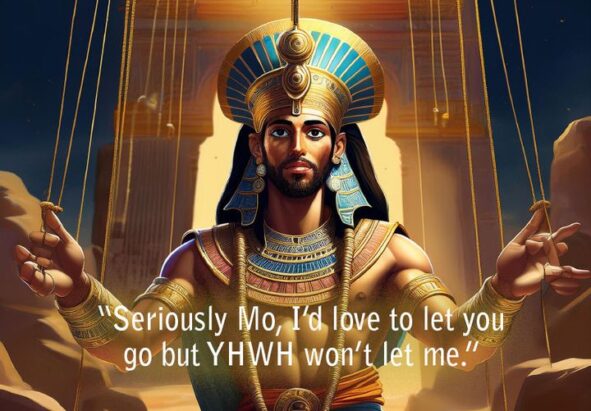
GOD BRAGS ABOUT CONTROLLING THE KING’S BEHAVIOR
AS AN EXCUSE TO DESTROY EGYPT
Genesis > Ex. 8:15 | Ex. 9:22 | Ex. 10:1 | Ex 14:4 > Leviticus
WARNING: Genocide, infanticide, plagues, blood,
CONTEXT: ~ 1250 BCE If this event were historical, it would have taken place right around the time of the Late Bronze Age Collapse (LBAC) and the Trojan War.
There is a hugely important yet studiously overlooked component of the inspirational Exodus myth: The “let my people go” line is memorable, but ignores the real issue. Pharaoh won’t allow the people to go because God won’t allow him to allow the people to go. YHWH sets the whole thing up to humiliate Pharaoh, who he clearly considers a rival: the result is hundreds of thousands of innocent Egyptians deceased or itching.
An old standby in bullying behavior is the “self harm” scenario. In this involuntary game, one child grabs the hand of the victim and forces them to punch themselves, all the while demanding to know “why are you hitting yourself? Why are you hitting yourself?”
Depending of course which end of the smacking you are on, this relatively harmless abuse is unlikely to generate therapy sessions decades later. However, it is quite a bit more consequential when the creator of the universe pulls essentially the same stunt on the absolute monarch of one of history’s greatest and long-lived empires.
Nevertheless, this is exactly what YHWH does to Pharaoh as he guides Moses through the farce of the Passover story: the utter destruction of the nation of Egypt and the mass murder of up to half a million of its children (see Bible body count).
Because the Exodus fable is a favorite of Christian Sunday School propagandists, it sidesteps most critical scrutiny. As a result, YHWH’s gleeful control of the Pharaoh’s actions is rarely noted in religion class. Most involuntary Bible students (in other words, most Bible students) would tell you that Pharaoh hardened his heart against the chosen. But he didn’t and the scriptural text doesn’t say he did. God hardened it for him and without his knowledge. The insecure and sadistic god of the Hebrew Bible is clearly enjoying the process.
It creates an uncomfortable moral conundrum for “God” to brag that he is creating an excuse to show Pharaoh who’s the king of the forest…if the Lord is who he claims to be, why does he need any justification.
The scriptural account of Exodus is not an ambiguous narrative open to a range of interpretations. In Ex. 4, God begins boasting early and often how he is going to literally prevent Pharaoh from releasing his Hebrew slaves. As the Lord gleefully explains, he is unequivocally controlling the king’s behavior so that he can punish him in all kinds of cruel ways (even though most of his vengeance falls upon ostensibly innocent Egyptians and their livestock – especially the livestock). This is like a ventriloquist beating up their dummy even though the puppet is under their control.
But this is supposed to be GOD, man. Why does he need to go through all this?
Because YHWH intends to show us signs.
“But I will harden Pharaoh’s heart, and though I multiply my signs and wonders in Egypt he will not listen to you. Then I will lay my hand on Egypt and with mighty acts of judgment I will bring out my divisions, my people the Israelites. And the Egyptians will know that I am the Lord when I stretch out my hand against Egypt and bring the Israelites out of it.” – Ex. 7:3-5 [KJV]
God goes on to announce essentially the same plan in Ex. 8:15, Ex. 9:12; Ex. 10:1 and Ex. 14:4.
His message is consistent: YHWH is causing Pharaoh to commit a crime so that he can punish him for the same crime. Today we would call it entrapment.
Obviously this aspect of YHWH’s behavior does not bear close scrutiny, but that is only one component of a greater set of problems in Exodus. God’s command over the king’s decisions calls into question the very concept of free will. If the Pharaoh can be held accountable for behavior he doesn’t control, then what is the status of the rest of humanity? This question is a small part of a much larger quandary, perhaps the most intractable challenge across a spectrum of philosophy, religion and quantum physics.
The other troubling aspect of Pharaoh’s punishment is the abject tribalism that is the core theme of most Old Testament stories. If you are not an Israelite, you are bad. If you worship the wrong god, you are not only bad, you should be exterminated (except for virgins). Divine guidance regarding right or wrong, good behavior or decency is entirely incidental. What matters is who you worship. In this value system, the inhabitants of Egypt are evil simply by virtue of being subjects of the Pharaoh/sun god. Recall in Genesis that an earlier Pharaoh was portrayed as a rather decent guy four hundred years previously when Jacob migrated to Egypt.
There are limitless other housekeeping items to be dealt with in the Exodus story, but we will only note a few more here.
> Is Aaron no longer a slave? What’s he been doing for eighty years? How does he get time off? Why not just have the older Aaron handle the assignment instead of bringing in Moses all the way from Arabia? Put another way: there doesn’t seem to be much compelling about Moses. And he is a bit of a whiner.
> Do slaves simply walk into Pharaoh’s court to threaten the king and show off magic tricks?
“Two slaves to see the King, sire!”
“Did you tell them that I am Lord of the Two Egypts,
Upper and Lower, and son of Ra, the Sun, whence comes all life?”
“It didn’t come up Sire.”
“OK, no big deal. Send them in.”
> Moses is told to ask for a three day holiday excursion into the wilderness for the purpose of worshiping YHWH. He is not instructed to demand a permanent release from slavery. Why does the creator of the Universe need to lie to Pharaoh about the purpose of the visit?
> And finally, following the passionate and extended moaning about the horrors of slavery, we are treated later in Exodus and the Pentateuch to a long sequence of regulations concerning how Israelites are to treat their own slaves. It appears that the problem is not slavery itself, only enslaving Israelites. This material proved to be a favorite among good Christian slave owners, who produced a version of the Bible for their slaves.
The issue here is not about good and evil or what constitutes righteous behavior. It is only about whose side God is on. In the fundamentalist branches of virtually all religions, we see exactly where that scenario leads.

Pharaoh won’t allow the people to go because God won’t allow him to allow the people to go
“When you return to Egypt, see that you perform before Pharaoh all the wonders I have given you the power to do. But I will harden his heart so that he will not let the people go.”
– Ex. 4:21 [KJV]
NOTES:
- According the Biblical time line, the Israelites have been slaves for about four hundred years. Pharaoh must wonder why the sudden interest in a getaway weekend for worship. Not to mention, as pointed out in True Scripture: Book of Exodus, the Israelite population would have exceeded two million and would have most likely been about two-and-a-half million. The logistics of the jaunt, of course, are not even remotely possible.