
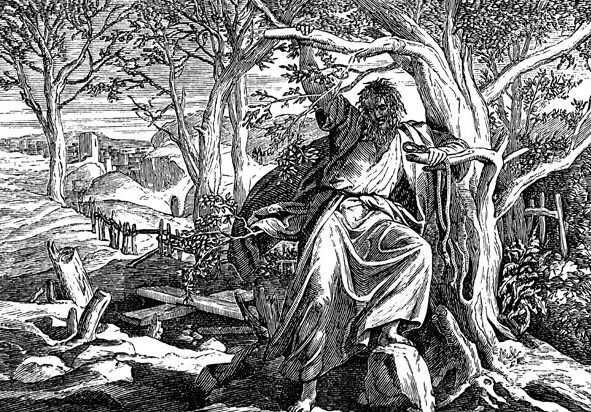
DID JUDAS HANG HIMSELF OR DID HIS BOWELS SPONTANEOUSLY EXPLODE?
Matthew 27:5 | Acts 1:18
WARNING: Betrayal, suicide, gross internal body parts
CONTEXT: ~ 30 AD The betrayer Judas may have hanged himself, or he may have stumbled and caused his guts to explode, but he didn’t do both.
Back there in Sunday School we were taught the whole “New Testament” saga as if it were a chronological narrative of Jesus’s life. But that’s not what’s in the Bible. The accounts in the Four Gospels are decidedly not a linear description of events. The version you get in church is cobbled together from writings attributed to Matthew, Mark Luke and John, each of which contains some material either inconsistent with the other three books or downright contradictory.1 In the latter category is the sad, cautionary account of how the turncoat Judas Iscariot ended his days. Which is to say: there are two distinct accounts of his death, which are not even close to similar to each other.
As the story goes, Judas receives a bribe from the Temple authorities and betrays his master with a kiss in the Garden of Gethsemane.2 Following ben Joseph’s arrest and execution, the New Testament presents us with two separate stories as to how Judas meets his end and two conflicting explanations of how he spends the blood money. These accounts are seriously at odds. One of them is typically recited in church, the other is generally ignored.
STORY SUMMARY: CONTRADICTORY ACCOUNTS
The Gospel of Matthew tells us that Judas hanged himself. The Book of Acts says he fell down in a field and his guts spilled out. Further, the Gospel of Matthew tells us that Judas first discarded the silver pieces in the temple, a clear sign of regret and self-hatred over his duplicity. The chief priests use the coins to purchase a plot of land for the burial of foreigners.
But in the Acts version, Iscariot is less remorseful. He uses the thirty pieces to buy himself some land, whereupon he immediately takes a most unfortunate tumble. In the peculiarly truncated chronology of the Bible, he buys the land, falls down and his insides more or less explode, a probable sign of divine displeasure.
- In one case, he takes his own life and in the other he dies either by the hand of YHWH or by an accident so unlikely it has never happened to anyone else
- In one case he rejects the blood money and in the other he spends it.
The two versions offer quite different moral underpinnings: one is about remorse, the other about retribution. All that notwithstanding, they are fundamentally different accounts that can’t be reconciled.
They are not both true.
An Inerrancy Error
This discrepancy doesn’t particularly matter in the retelling and retelling and retelling of the extended Easter story, but it does absolutely matter if you are committed to Bible inerrancy,3 a sketchy but pervasive world view that insists every word of the Bible is literally true.
Compare the text from each account.
Matthew 27:5 “Then Judas, His betrayer, upon seeing that He had been condemned, repented and returned the thirty pieces of silver to the head priests and elders, saying, “I sinned, by surrendering innocent blood. Then he threw down the pieces of silver in the temple and departed, and went and hanged himself.”
Acts 1:18 “Now this man purchased a field with the wages of iniquity; and falling headlong he burst open in the middle and all his entrails gushed out.”
Inerrancy theologians are not unaware of these contradictions, so they have developed tortured explanations for how the Bible doesn’t really say what it indeed does say. Pretzel logic, if you will.
On the Answers In Genesis website – brought to you by the folks who run the taxpayer subsidized Ark Encounter in Kentucky – the reasoning is the very definition of a faulty syllogism: the two tales can’t be contradictory because the Bible is inerrant. Thereupon follows an utterly delusional and yet somehow condescending explanation of how these two accounts are both true: After he hanged himself, he fell down and then his intestines burst. Or something along those lines. Is it rude to point out that one generally can’t walk run or stroll after being hung?
Other apologists claim that the traditional site of Judas’s death is a high windblown ridge. This causes Judas to slip the hanging noose and fall down the ridge, which blows open his stomach. There actually is no such location mentioned in the scripture, so this is simply made up.
As lame as that and similar efforts are, none of them deal with the other critical component of the story: what happened to the money? If Judas returned the money to the priests, how did he use it to buy the land? Especially after he committed suicide? If he used the silver to purchase land, as noted in Acts, it suggests a much lower level of regret.
So when you hear the inspiring snippets read from the pulpit on big money holy days, you are getting only a small segment of what’s really in there between the pages. And that is not an accident.
If a document contains two accounts of the same event that clearly and unambiguously contradict each other, then the document is not inerrant.

Two Contradictory Stories of Judas’s Death
NOTES:
- The “four apostles” (Matthew, Mark, Luke and John) are not historical personages and certainly not among the twelve disciples of the individual named Joshua ben Joseph. The “gospels” were not contemporaneous with the events depicted and in fact were written some decades after the letters of Paul. They were heavily edited and redacted over the years by multiple authors. The Gospel According to Mark, for example, was written about forty years after the execution on the cross. It was used as a source by the authors of Matthew and Luke. Manuscripts with “according to” in the titles do not start appearing until around 200 CE.
- Considering the high profile Jesus was enjoying in Jerusalem during Passover week, not to mention the halo over his head, it’s hard to imagine the Temple authorities couldn’t locate him without a peck on the cheek from Judas.
- Inerrancy: That is: every word of the Bible is literally true, no matter how unlikely, impossible, contradictory or ridiculous.