
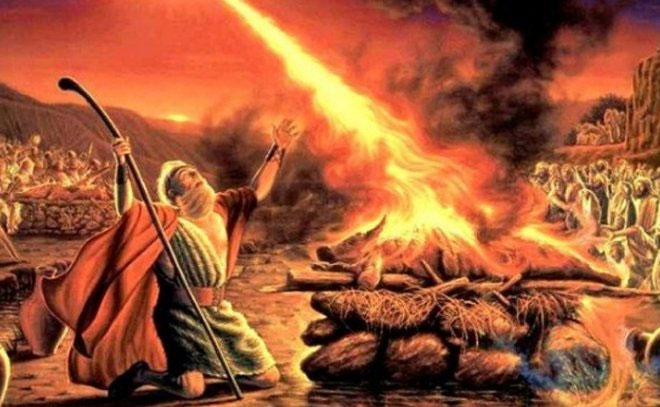
ELIJAH AS HARRY POTTER
2 Samuel > 1 Kings 18:20-24 > 2 Kings
WARNING: Divine bowel movements, animal sacrifice, mass murder
CONTEXT: ~ 860 BCE1 Thirty years after the split between the Israel and Judea over excessive taxes, the prophet Elijah humiliates the King of Israel, his wife Jezebel and their god Baal Hadad.2
One of the snarkier quips in the Old Testament is encountered during a magic competition between YHWH’s prophet Elijah and King Ahab’s royal court shamans as they strive to summon their respective deities for the purpose of igniting a sacrificial bull.3 Gods of all types love offerings. The nation of Israel takes the day off to watch the event, which takes place on Mt. Carmel.
The premise of the conflict is that Ahab, king of the Northern Kingdom of Israel,4 has given his evil wife Jezebel free rein to set up her Baal shrines and altars in opposition to the worship of YHWH. Jezebel has killed most of YHWH’s prophets and the rest have been hidden in caves by an individual named Obadiah. This has aggravated YHWH to the point that he brings down drought and famine on the kingdom.
Elijah is YHWH’s designated emissary to the royal court of King Ahab, a risky career choice at best given the malevolent queen’s propensity for killing competing holy men. Meeting up with King Ahab, he suggests a competition between the two gods – YHWH vs. Baal – challenging the royal priest/prophets to a mountaintop duel (not unlike Moses’s dick size contest with Pharaoh’s priests in Exodus).
In this contest, Elijah is confronted by a decidedly uneven playing field. Backed by Queen Jezebel, Baal currently employs four hundred fifty priests backed up by four hundred “prophets of the grove.”5
After futilely haranguing the assembled Israelites to choose between Baal and YHWH, Elijah sets up the match. He lays firewood and chopped up chunks of two bulls on the altars and invites the witch doctors to pick either one. They are to bring down their deity’s sacred fire from the heavens to start the barbeque.
After hours of importuning Baal, wailing and jumping up and down on the altar, the bull carcasses remain unlit and the distraught Baal guys are beside themselves with embarrassment. They cut themselves until they draw blood and engage in all manner of self-harm. This is when Elijah begins to taunt them:
“And at noon Elijah mocked them, saying, “Cry aloud, for he is a god. Either he is musing, or he is relieving himself, 6 or he is on a journey, or perhaps he is asleep and must be awakened.” – 1 Kings 18:27 [ESV]
In other words, Baal can’t light your fire because he is taking time off for an extended bowel movement. Or he may just be napping.
When his turn comes, Elijah repairs the broken down altar to YHWH and calls down a monster pyrotechnics demonstration worthy of Mt. Sinai, igniting the sacrificial bulls with the help of his divine boss. The people see the error of their ways and slaughter all of the Queen’s priests and prophets of Baal at Kishon Creek. The death toll is eight hundred fifty.

“Cry aloud, for he is a god. Either he is musing, or he is relieving himself.”
NOTES:
- At this point in the Hebrew Bible, we are transitioning into a narrative thread that is more or less historically accurate.
- The normal term for this ancient Canaanite/Hebrew fertility god is just “Baal.” However, Baal means “Lord,” so the deity’s name would have been “Lord Hadad.” There is extensive archeological evidence that YHWH, El and other regional gods were often worshiped simultaneously and that the hierarchy of deities was more fluid than described in biblical Yahwist propaganda.
- It is not generally appreciated that the job description of “prophet” was considered a legitimate career path in the ancient world. There were various type of prophets, the best paying being those associated with royal courts. These were political appointees who supported the monarchy as astrologers and magicians. They were in a position to provide divine back up for decisions made by the king. See our accounts of Pharaoh and The Wise Men. There were also the more famous freelance prophets of the Old Testament who were a usually thorn in the sides of kings, with a tendency to call the nation of Israel to account for its sinful ways. Jeremiah and several other biblical prophets were likely based on historical characters, although the writings have been heavily edited over millennia.
- The northern kingdom of Israel split off from the southern Davidic kingdom of Judea over excessive taxation under Solomon . Also known as Samaria, Israel was historically less enthusiastic about the YHWH cult, with tensions also arising over officially sanctioned places of sacrifice. A significant portion of the Old Testament is royal court agitprop addressing this power struggle, heavily slanted toward the YHWH proponents.
- The Hebrew Bible is full of pejorative references to “groves.” The disdainful allusion is to worshipers of Baal and other Canaanite deities who practiced their cult rituals in wooded enclaves as opposed to the far more expensive Temple in Jerusalem. From the perspective of Yahwist priests, this was unauthorized competition for the Temple hierarchy.
- Although the holy scriptures are capable of soaring the great spiritual heights, they also descend surprisingly often into the realm of toilet humor.
.