
JACOB’S SONS COMMIT A HORRIFYING ACT OF VIOLENCE
Genesis 34 > Exodus
WARNING: Rape, deception, mass murder
CONTEXT: ~ 1800 BCE After many conflicts and family drama in Syria, Jacob leads his family into Canaan, where they immediately commit an atrocity
As is the case of many Old Testament stories, this one doesn’t often make the lesson cut in Sunday School class or selected scripture readings.1 Although it flies under the radar for reasons that will become obvious, it is a factor in later events described in Genesis. This particular story feels especially painful for men, as it involves the wanton murder of male Shechemites who have just been circumcised. Let’s see if we can find a moral high ground.
SUMMARY
Jacob’s extensive clan and their livestock are looking to settle in Canaan after migrating from Syria.2 Having just been renamed by God, Jacob/Israel purchases a plot of land outside the Hivite (Canaanite) city of Shechem, a large town located in what is today the West Bank. He sets up an altar there3 and calls it El Elohe Israel.4
The land is sold to him by Hamor, ruler or head man of the Shechem region. As a herder, Jacob plans to settle his extensive clan near the town and engage in trade with the city-state. No sooner does the clan arrive than his adventurous daughter Dinah decide to head into town to see what’s shaking. It was here that she encountered Shechem, young prince of the city and son of Hamor. The two young people hit it off, and at some point engage in coitus, which is generally portrayed as a rape.5
Jacob is oddly passive when he hears the news. How does he find out? Presumably it doesn’t come from Dinah, because she is still in the city with the prince. Surprisingly, Jacob waits until his sons get home from the fields to tell them the bad news (“Oh by the way, there was a bit of any awkward incident while you were at work.”) at which point the sons more or less lose their minds.
To complicate matters, Prince Shechem has fallen madly in love with Dinah after defiling her.
“And his soul clave unto Dinah the daughter of Jacob, and he loved the damsel, and spake kindly unto the damsel.” – Gen. 34:3 [KJV]
He prevails upon his dad to buy Dinah from Jacob. For his part, Hamor appears to be an indulgent dad and also rather a decent sort. He meets with Jacob and sons in an effort to solve the unfortunate situation in a reasonable way. Not only does he propose an outrageously large dowry for the daughter of livestock herders, he also wants to merge Jacob’s family into the commerce and social life of Shechem. He wants everyone to intermarry. Open up housing. Do business. Integrate the shepherds into urban life. The smitten prince chimes in, promising that he will provide whatever bride payment Jacob demands.6
Here is where things get morally dicey. The sons of Jacob prove they inherited their father’s well known guile. They tell Hamor and Shechem that they can’t possibly enter into this agreement unless all the males of the city get circumcised.7 The king and prince gladly agree. They talk the men of Shechem into getting circumcised immediately and paint a rosy picture of the future.
But that isn’t what Dinah’s brothers have in mind.
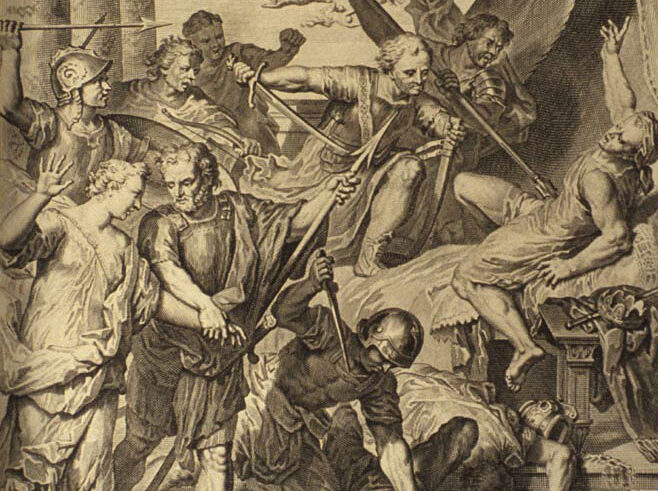
And it came to pass on the third day, when they were sore, that two of the sons of Jacob, Simeon and Levi, Dinah’s brethren, took each man his sword, and came upon the city boldly, and slew all the males. And they slew Hamor and Shechem his son with the edge of the sword, and took Dinah out of Shechem’s house, and went out. The sons of Jacob came upon the slain, and spoiled the city, because they had defiled their sister. They took their sheep, and their oxen, and their asses, and that which was in the city, and that which was in the field, And all their wealth, and all their little ones, and their wives took they captive, and spoiled even all that was in the house. – Gen. 34:25-29 [KJV]
Overkill. guys?
In terms of cultural expectations, it probably doesn’t matter whether Shechem technically raped Dina or not. This is an honor killing no different that Islamic versions of the same.
It is certainly of passing interest that we are never given any insight as to Dinah’s feelings at any point in the story, even as the situation spirals downward. Although her brothers are conducting an over the mass murder, they kill the prince in the process. In the Talmud version, they also torture him. But we have no record that they ask Dinah how she feels about the death of the prince, at least according to the written word. We hear no more about her after they take her back home to the tent.. Did Dinah want to be avenged?
As for Jacob, he remains consistent to his reputation. His concern is not about the horrifying slaughter, kidnapping and plunder his sons have perpetrated. He is concerned that neighboring peoples will bring ruin upon him.8

And it happened that on the third day, while they were in pain, two of the sons of Jacob, Simeon and Levi, the brothers of Dinah, each took his sword and came against the unsuspecting city and killed all the males. 26 They killed Hamor and his son Shechem with the edge of the sword, and they took Dinah from the house of Shechem and went out.
– Gen 34: 25 0 28 [LEB]
NOTES:
- The best selling novel the Red Tent is based on this episode..
- There is a puzzling question related to Jacob’s wanderings: why doesn’t God give any of the patriarchs the land promised in the Covenant? There is indeed one place where a reason is given: Genesis 15:16: “Then in the fourth generation they will return here, for the iniquity of the Amorite is not yet complete.” This is not the usual reason he gives for punishing the chosen people, which is that they are sinful. Instead, he is making them wait many generations (let’s not quibble about the number of generations) because of someone else’s sinfulness. Let’s be honest: this is pretty lame.
- Abraham and Jacob set up quite a few altars in their wanderings. But these were more like piles of stones – commemorative mile markers perhaps – compared to the working altars intended for the animal sacrifices at the core of ancient religions.
- You may have noted that the two letter syllable “El” as a component of many place names in the Hebrew Bible. It’s the literal name of the Canaanite god, it is also a generic term meaning “a god” and also the predominant god of the early Hebrews. El appears three times in the name of the altar Jacob has built. Isra-El means struggles with god. So the extended interpretation of the altar name is: god (El) who is the god (El) of they who struggle with God (El).
-
The exact nature of this sexual act is not clear in the scripture. The implications varying from translation to translation. The Complete Jewish Bible [CJB] is rather insistent on the rape scenario:
“…he saw her, grabbed her, raped her and humiliated her.” [CJV] This is not surprising, as it provides incrementally more justification for the crime that is to come.
The King James Version is not quite so aggressive: “(he) saw her, he took her, and lay with her, and defiled her.” [KJV] Does this imply a more consensual scenario? It depends on the viewpoint of the translator.
- Considering Jacob’s family numbers fewer than a hundred, it is likely that Hamor could easily summon more than enough military muscle to defeat the Israelites if they want to make an issue out of it..
- In conceiving and perpetrating this deceit, the brothers are leveraging the sacred contract with YHWH. Not cool.
- The portrayal of Israel’s enemies is uneven throughout the Hebrew Bible. In this particular story, the Canaanites are closer to being the good guys than the Israelites.