
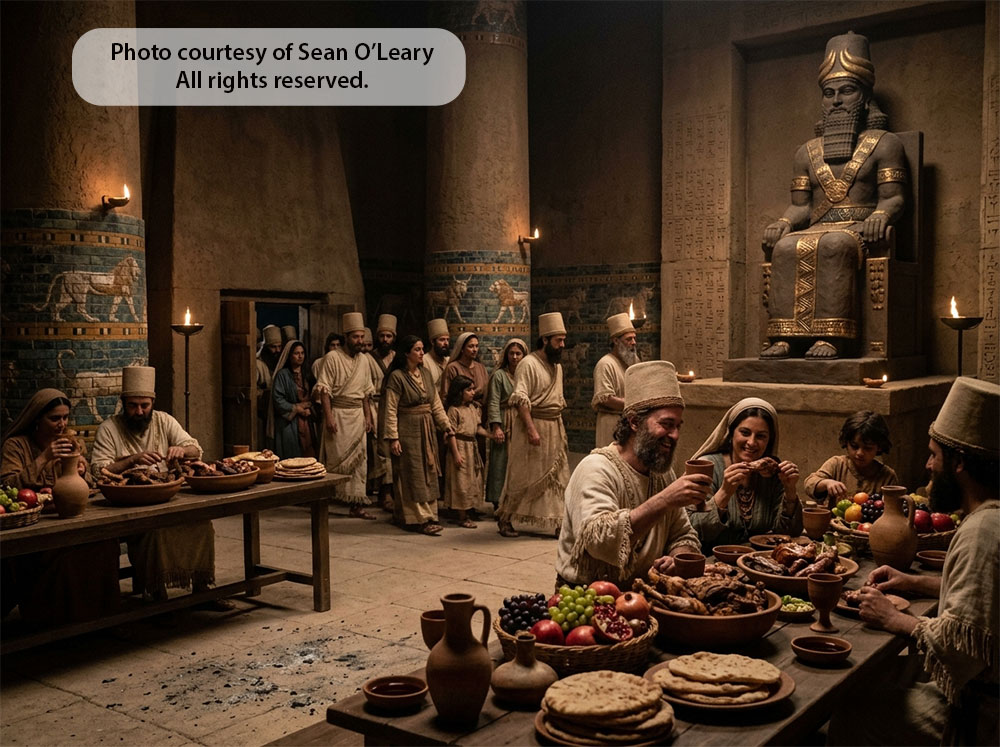
DANIEL KILLS A BABYLONIAN DRAGON AND BUSTS THE PRIESTS OF BEL
Daniel 14 > Hosea
WARNING: This portion of the Book of Daniel is found in the Catholic Bible, but not Protestant versions.
CONTEXT: ~ 605 – 539 BCE Spans the early days of the Babylonian exile into the era of Persian empire. As the Persians take over, Daniel makes the transition from bestie to King Nebuchadnezzar to boon companion of King Cyrus the Great.
OUTING BEL’S PRIESTLY SCAM
Unless you happen to be a priest of Bel, this wicked snippet of a story is rather amusing. It portrays the local god’s acolytes as tricking Cyrus, King of Persia into providing vast quantities of luxury cuisine and vino for the deity to eat every night.
The hero of the story is Daniel, the same one who will soon survive the lion’s den. In the Bel cautionary fable, Daniel’s pal the king of Persia1 tells him how cool the Babylonian god “Bel” is. Daniel says he doesn’t think Bel is a real god because he’s made of clay and bronze, and therefore not a living god like YHWH.2 The King insists that Bel must be real, because every night his giant idol in the temple eats astounding amounts of food and drinks gallons of wine: “Twelve great measures of fine flour, and forty sheep, and six vessels of wine.” As far as Cyrus is concerned, that evidence is conclusive. Nevertheless, Daniel says the whole thing is a fraud and he can prove it.
This sets the ruler of the Persian empire off, and he demands that the seventy priests of Bel prove to him it is the deity Bel consuming the offerings every night. The smug priests tell the king to layout the lambchops and wine as usual and then seal the entrance to the temple with his ring. With the temple locked and sealed, only the god will be able to consumer the feast. They further propose that if Bel doesn’t chow down, the king can execute the priests. However, if the food and drink is gone, Daniel is to be killed.
After the priests leave, Daniel scatters ashes around the temple floor in the presence of the king. Cyrus and Daniel leave the temple and the door is sealed. The next morning, the king sees that the food has been consumed and triumphantly points out that the wax seals on the doors are unbroken. He congratulates the idol of Bel. But Daniel points out the many footprints in the ashes on temple floor: adult and children.3 It turns out the whole priestly crowd has been sneaking in through a secret door and treating themselves to a nice spread every night. The King of Persia has been picking up the tab all along.
The priests of Bel are arrested, whereupon they render full confession and show the king the secret door.4 All seventy of Bel’s shamans, their wives and children are put to death. Daniel gets to gleefully to destroy the idol of Bel and the temple.
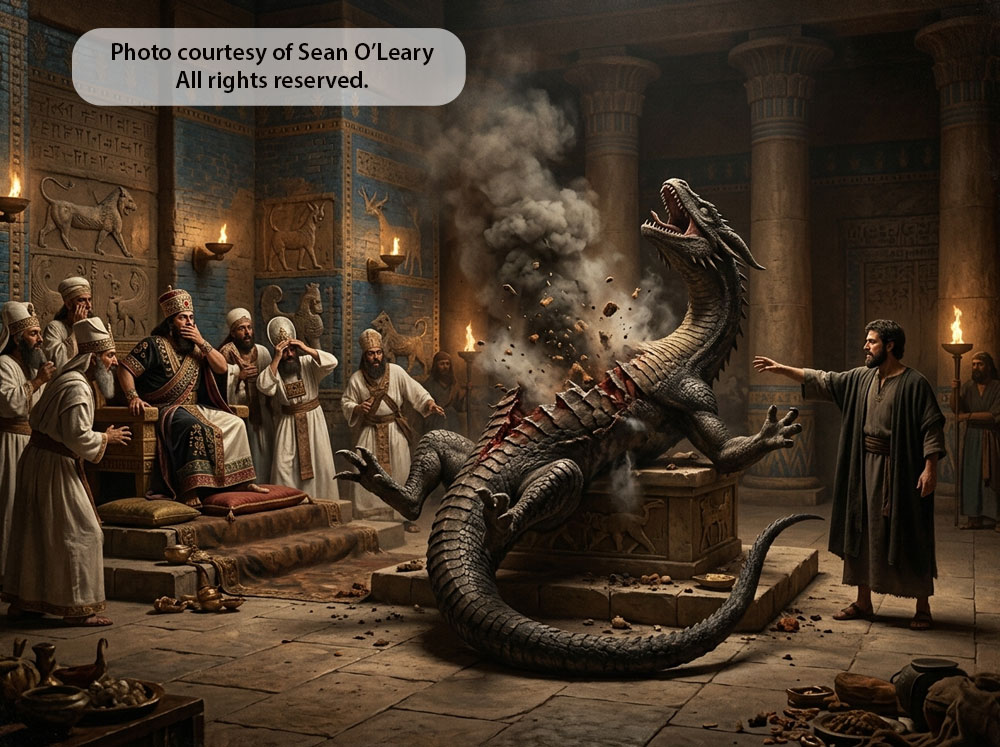
LET THE DRAGON EAT CAKE
Daniel is soon tested again, as Cyrus finds another Babylonian deity that is currently all the rage. This god is described only as a great dragon.5 Cyrus the Great, possibly still miffed over the Bel incident, commands Daniel to worship the dragon. His royal logic is that this is a living dragon, so therefore more real than the clay deity Bel previously outed by Daniel.6 As always, Daniel explains he will worship only YHWH and offers to kill the dragon without even raising a sword. The king of Persia gives him the thumbs up.
Daniel mixes up tar, fat and hair and bakes it into cakes. He feeds the vakes to the dragon, which bursts open and dies.7 Daniel taunts the Babylonians for worshiping this fraud of a god.
“The Babylonians” are indignant and accuse the King of the Persian Empire of becoming a Jew. They threaten him and his family with death unless he turns Daniel over to them. So Cyrus the Great gives Daniel over to the Babylonians.8
At this point occurs the famous story of Daniel and the Lions Den. Interestingly enough, this is a repeat of the story told in Daniel 6 with some variations including the number of lions. It also takes place under the reign of a different king. Is Daniel just the kind of annoying guy who invites this type of punishment? Don’t the Persians know that it didn’t work when the Babylonians tried it? Or it it possible that both stories are more or less fables?

“Then the king was enraged, and he seized the priests and their wives and children; and they showed him the secret doors through which they were accustomed to enter and devour what was on the table.”
– Book of Daniel 14: 21 [RSVCE]
“Then Daniel took pitch, fat, and hair, and boiled them together and made cakes, which he fed to the dragon. The dragon ate them, and burst open. Then Daniel said, “See what you have been worshiping!””
– Book of Daniel 14: 27 [RSVCE]
NOTES:
- This is Cyrus II (the Great), founder of the Persian Achaemenid Empire and the king who freed the Jews from captivity in Babylon. That is all historically accurate. However, among the credibility issues with this tale is that it is set in Babylon rather than Persepolis in Persia. It is full of prophecies, but scholars generally contend that it was written well after the events portrayed and therefore had an advantage with regard to foretelling the future.
- Most of the time humans can’t see YHWH at all.
- It is a little surprising that the priests might have noticed the ashes on the floor at some point, especially considering they knew they were under suspicion.
- Shamans and priests have been using subterfuge to fool the rubes into donating money and possessions since the beginning of time. Ancient priest/shamans were adept at magic, as seen in Biblical competitions such as Elijah vs Baal‘s priests.
- The Babylonian dragon/god joins many other magical creatures of the Bible, including the sea serpent Leviathan, the chaos monster Behemoth, unicorns, a talking donkey, a flying beast called Ziz, several giants, the Niphilim and extremely tall angels.
- The fact that we are talking about a dragon doesn’t appear to be unusual for the characters.
- Just curious if Daniel just walks up to the nice dragon and hand feeds him? “Here’s a nice cake boy.”
- Cyrus the Great at this point has conquered one of the largest empires of all time. So the idea that “the Babylonians” are going to kill him and his family is a bit of a stretch.