
A retelling of Ludlul bēl nēmeqi
(Sumerian Poem of the Righteous Sufferer)
Ester > Book of Job > Psalms
WARNING: Mass murder, divine bragging, unicorns, sea monsters
CONTEXT: The Book of Job occupies its own time and space, with virtually no relationship to any other material that comes before or after.1
Scripturally speaking, the iconic Job is not necessarily the faithful doormat of common legend; furthermore, the man can bang out a lament as well as any Babylonian exile. While it is accurate to say that Job never does quite bring himself to curse God after his cataclysmic misfortune, that doesn’t mean he doesn’t throw some shade at this self-righteous friends and even at YHWH himself. Yet most Christians are taught a highly edited version of the biblical Book of Job, leaving the most intriguing parts unread and untaught.
A Loving God And His Pal Satan
Most regular Christians and Jews know the story of Job, a tale which has spawned more than its share of clichés, the most common of which is “the patience of Job.” But as is the case with so much biblical material, good church goers are typically exposed only to the Sunday services version of the tale. On closer examination, however, the popular lesson that we must stoically accept God’s will is not necessarily the core message of this fable. The more accurate take away is that God is arbitrary and arrogant, and not as concerned with the welfare of humanity as he claims elsewhere.
For a reader not pre-programmed to accept the Bible as literal truth or even workable spiritual guidance, the natural reaction to reading the whole of this brutal saga might be: this is the benign sky god we worship?
The complete original scriptural account is among the most interesting and morally complex to be found anywhere in literature. It ends with shockingly blunt and cynical observations from the Creator himself. The poetry is eloquent and powerful, worth reading in its own right, as are the bragging rants of YHWH as he admires the monsters he has created for no apparent reason. Take up the King James Version and read it for yourself.
Plot Summary (Sunday School Version)
Job is a rich man with an ideal family who is almost comically upright. Unfortunately, God brags about him to his heavenly advisory council, spurring the Lord’s personal prosecuting attorney Satan to test Job’s faith. As a result, Job loses his home and all his possessions; his children are murdered. Nevertheless, he will not curse God (although he does take some time to bemoan the day he was born).
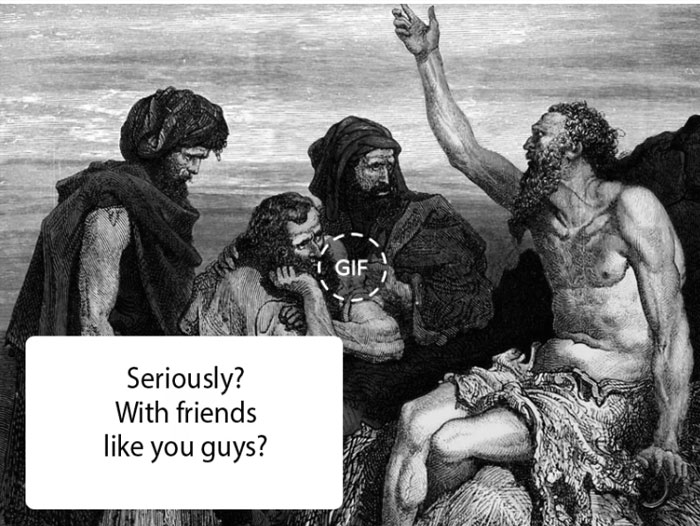
Job’s so called friends line up to accuse him of sinning, based on the prima facie principle that God is a just and fair deity and therefore Job must have caused his own downfall. This is a master class in victim shaming.
Job and YHWH have a very strange heart to heart, and we enjoy a front row seat as the Lord elaborates at length on his high opinion of himself – and not for the first or last time.
Job questions why he has lost everything, but eventually admits that he does not have the wisdom of God and cannot know everything. God gets tired of the piling on at some point and appears out of a whirlwind to discipline the friends and straighten out their thinking. He then restores Job’s wealth twofold and provides ten replacement children.
The Extended Lesson: “Get Over It Job” (God)
The fabulously wealthy Job lives in the desert regions east of the Jordan River. He is not only good, he is perfect. He has seven sons, three daughters, seven thousand sheep, three thousand camels, five hundred yoke of oxen, and five hundred she asses. As the main man of the “East,” Job is pre-emptively righteous. He purifies his children by offering burnt sacrifices just in case the kids sin accidentally or neglect to do their own atonement.
One day YHWH is holding a council of his advisors, a group of assistant deities that includes the Satan.2 Let’s be clear that Satan is not the devil in this context, he is God’s lawyer or “advocate.” The Hebrew is word is “hassatan” which can also mean “adversary” or “prosecutor.”
The Satan reports that he has been wandering the earth, taking a look around. God proudly asks if the advocate has come across his virtuous poster boy Job in his travels. Ever contentious, the Satan points out that Job has no reason not to be a model citizen: YHWH has given him everything and protects him from all harm.3 Satan predicts that Job will curse God pretty darn quickly if his stuff is taken away. God tells Satan he can do his damnedest, as long as he doesn’t hurt Job physically.
The Satan takes YHWH at this word: he destroys everything that Job has and murders his whole family. He deploys Sabeans to kill the servants and steal the donkeys,3 then hurls a firestorm from heaven to barbeque Job’s livestock, sends some Chaldeans on a specific mission to steal the camels and finally a derecho wind to knock down his kids’ houses and crush everyone inside to death. 4
Job’s response is to rend his clothes and fall down in worship, delivering his classic line:
“Naked came I out of my mother’s womb, and naked shall I return thither: the LORD gave, and the LORD hath taken away; blessed be the name of the LORD.” – Job 1: 21 [KJV]
He does not sin, however, even given the excuse that his family has been murdered and his possessions stolen or burned.
At the next meeting of God’s angelic advisory committee, YHWH points out that Job did not curse him as Satan had predicted. So to make sure he is really tested, they afflict Job with boils so painful that he has to scrape them with potshards. Even Job’s wife encourages him to curse God at this point and just go ahead and die. But he refuses and is left sitting on an ash heap.
Three friends come to pay a condolence call. They sit on the ground with Job for a week before launching a barrage of condemnation. The hero then takes up an entire chapter with a very powerful poem cursing the day he was born in almost every way possible. The next several chapters consist of an extended poetic piling on, with Job’s rebuttals in between. Although these poems reward the patient reader with artful language, they are rhetorically convoluted and solipsistic. These verses are altogether Shakespearean but also not unlike a Philly freestyle rap battle.
Job’s first friend Eliphaz the Temanite points out that while Job has given advice to many in their time of need, he has not met his own standards as he sits devastated in the wreckage of his home. He suggests that Job’s troubles are the result of some hidden sin.
Job responds bitterly to Eliphaz, leaving the door open for second friend Bildad the Shuhite and eventually Zophar the Naamathite. These pals grow increasingly strident in their censure of Job, who returns the favor in kind. Bildad insists that Job’s children brought their deaths on themselves, while good buddy Zophar suggests that our hero deserved even worse than he got.
Each new segment is introduced by a rambling soliloquy on the topic of how long winded the other speakers are; nevertheless, as annoying as these guys are, they are world class wordsmiths!
Their consolidated message is biblical pretzel logic: God is perfectly just, therefore, if Job has run into some problems it must be due to personal sin on his part. Job’s agonized responses are punctuated by eloquent complaints about his friends:
“Miserable comforters are ye all. Shall vain words have an end?”
He accuses his friends of being “worthless physicians” who whitewash their advice with lies. While he doesn’t quite curse God, Job certainly questions him aggressively. “Mr. Patient” is not above sarcasm.
When this harrowing discussion is over, a random young fellow named Elihu enters the conversation with an extended commentary running from Job 32:6 through chapter 37. He is even more full of himself than the others and his message is painfully meandering. He does include the intriguing observation that physical suffering is an opportunity to realize God’s love and forgiveness. Thanks for that, Elihu.
When the new guy runs out of steam, the Lord appears abruptly out of a whirlwind, and he is not happy. He rejects the positions of Eliphaz, Bildad and Zophar as poorly informed regarding the workings of the world. He then segues into a tribute to himself as the hard working, over-burdened Creator of the world that would make Donald Trump blush.
He itemizes some of his greatest achievements, including an extended homily to a unicorn. Next, Chapter 40 is a tribute to YHWH’s chaos monster Behemoth and Chapter 41 is all about Leviathan the sea serpent, two fearsome fantasy and science fiction creatures that God is especially proud of. In fact, Chapter 41 is all about the giant sea serpent:
Can you pull in Leviathan with a fishhook
or tie down its tongue with a rope?
Can you put a cord through its nose
or pierce its jaw with a hook?4

Essentially, God’s message to Job and his pals is: Get over it pathetic mortals ! You have no idea how tough it is being me!
Job repents and apologizes for not understanding why God killed his whole family and destroyed his whole world for no reason. This is truly the ultimate in Stockholm Syndrome.
“The Lord has knowledge that surpasses what humans can know, Wherefore I abhor myself, and repent in dust and ashes.” – Job 42:6 [KJV]
God castigates the three friends and orders them to come up with a sizeable burnt offering (seven rams and seven bulls), which Job will administrate. YHWH guarantees he will accept Job’s offering. God never tells Job the truth: that he is not to blame, but was rather the victim of a gentlemen’s wager between a couple of callous heavenly popinjays.
The Lord then gifts Job double the wealth he had before; soon, his sisters and family come to visit and also give him jewelry. The new possession inventory is listed: he now has fourteen thousand sheep, six thousand camels, and a thousand yoke of oxen, and a thousand she asses. Yep. That’s double.
In case Job still feels a little traumatized, God also gives his guy ten new children! The new offspring are named, whereas, the original ten who were offed by Satan were not identified. Along these same lines, Job seems to have the same wife as before the unfortunate incident. Is it she who will give birth to the new brood of replacement children and if so, how does she feel about that?
From context in the beginning of the story, it is clear that the original sons and daughters were heads of their own households, so Mom would already be of a certain age. Is the Lord Almighty expecting the little wife to get busy with the breeding and rearing of a whole new family? What happened to the souls of the family God murdered?
Ultimately, contrary to the off again on again message of God’s all abiding love for his creation, the humans in the Book of Job seem to be nothing more than pawns in a gentlemen’s wager between God and one of his heavenly buddies. If Job ever figures out the nature of the plot against him, we are not told of it.
Don’t like that idea? Attend to God’s word Bro! Get over it!

Including mass murder, divine bragging, unicorns, sea monsters
NOTES:
- The burning question as to whether or not Job is an Israelite has consumed considerably more time than the topic warrants.
- The use of the definite article tells us that this is a title rather than a personal name. The council itself is a common theme in the ancient Near East and doesn’t suggest that this character is “the Devil” as portrayed in the New Testament. He doesn’t tempt Job directly as the Satan character in the Gospel of Matthew tempts Jesus (Matthew 4:1-11)..
- An interesting turn of phrase that occurs in most translations tells us that God “put a hedge around him.”
- Job 41:1-2. The sea serpent is mentioned in Psalm 74:12-19, 1.04:25-26; Isaiah 27:1 [2x]; Job 3:8; 41:1-34
.