
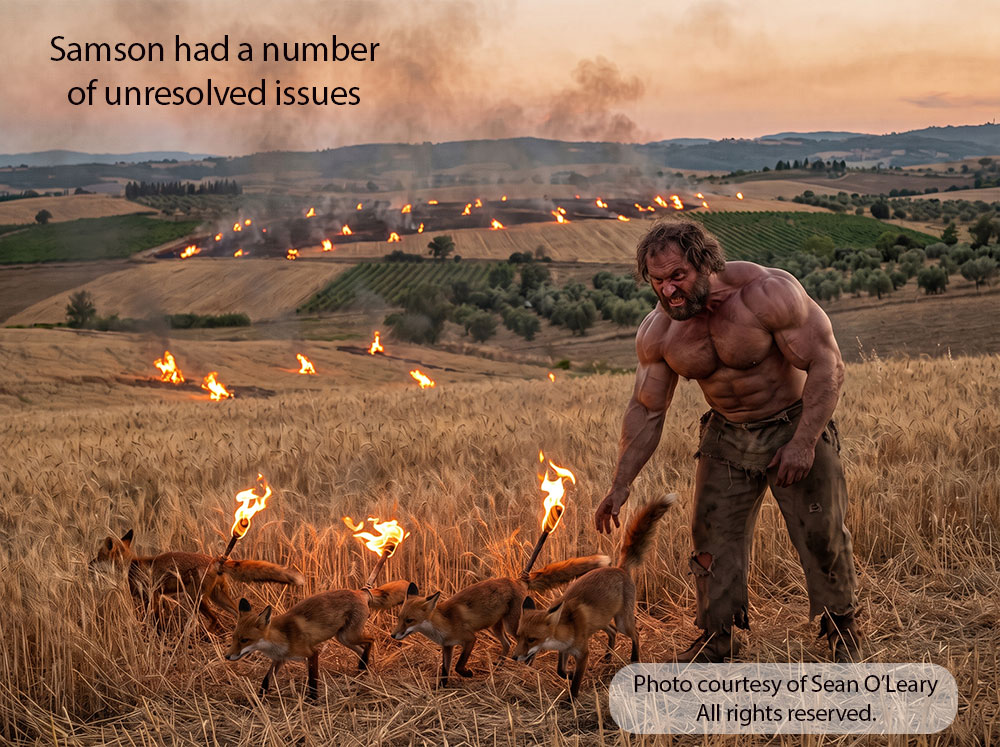
Samson sets fire to 300 foxes
THE BIBLICAL STRONGMAN NEVER FOUGHT FOR ISRAEL
Joshua > Judges 13 – 16 > Ruth
WARNING: Mass murder, whore mongering, animal abuse, more mass murder, riddle fraud
CONTEXT: ~ 1200 BCE Samson is one of twelve judges who more or less rule over Israel during the two hundred year period prior to the monarchy. He is the second worst.
As a poster child for flawed biblical anti-heroes, the strongman/judge1 Samson appears to be an adaptation of other Near Eastern folk tales, including the earlier Mesopotamian cycles of Enkidu and Gilgamesh. Because Bible narratives are promoting a point of view, fundamentally dishonorable characters such as David and Jacob get cut a lot of slack, resulting in deflection of critical thinking even in the face of stark facts. This is especially true of Samson, who is presented to young school children as a color champion of Israel in colorful Bible books.
According to the text in Judges, Samson is actually quite horrible: his feats of strength and martial prowess were undertaken settling his own grudges. He murdered indiscriminately. He cheated. He tortured foxes. He lusted after several Philistine women.2 In the Bible narrative, there is not a single mention of the mighty man going to war to save Israel.
While most everyone knows the cautionary fable of Samson and Delilah, the series of strange events leading up to the tragic denouement are rarely related. Many of these incidents are quite odd. Vignettes such as the mini tale of the lion’s carcass filled with honey may very well have some sort of metaphorical meaning, but it is quite unclear what purpose they serve.3
In fact, Samson was such a schmuck that trying to pinpoint his worst behavior requires a slog through a moral quagmire. Nevertheless, the wedding dinner riddle/mass murder scene described in Judges 14 is a righteous contender.
It goes like this boys and girls: Samson is in the process of marrying an unnamed Philistine4 woman, a more or less forbidden demographic for Israelites, especially a Nazirite.5 Contrary to the relentless scriptural demonization of the coastal dwelling Sea Peoples, our champion has an unfortunate hankering for the Philistine babes. At the pre wedding dinner, the groom challenges his guests to a bet, based on the following riddle:
“Out of the eater came something to eat, and out of the strong came something sweet.”
If the guests can’t come up with the answer in seven days, they have to buy Samson thirty sharp suits and thirty bedsheets. But here’s the thing: this is not a legitimate brainteaser at all. The question posed is based on another weird tale from the previous chapter, which describes how Samson tears a lion apart with his bare hands, and later finds a honey bee nest in the carcass (we’re skipping the details but you can enjoy it in Judges 14:5-6). Only Samson is aware of these events, so his guests are set up to lose.
Eventually, the wedding guests threaten the bride to be into cajoling her fiancée into revealing the answer to the conundrum con, which she shares with the attendees. Samson is most displeased when he loses the bet, but rather than pay up from his own pocket, he goes to the next town and kills thirty men.6 He then pays his debt with the stolen clothing of the recently deceased.
“And the Spirit of the Lord came upon him, and he went down to Ashkelon, and slew thirty men of them, and took their spoil, and gave change of garments unto them which expounded the riddle.” – Judges 14:19 [KJV]
The murders are committed with the enthusiastic aid, and we must assume approval, of God. The moral underpinnings of the Old Testament are far shakier than those of the Marvel Universe. He is not defending Israel. He’s committing armed robbery and first degree murder.
“If ye had not plowed with my heifer, ye had not found out my riddle.” Judges 14:18 [KJV]
The would-be swindler is outraged that he has been outsmarted and in the process, refers to his wife as a farm animal. He gives away his former fiancée to one of the wedding guests for his personal use. Plowing his heifer, as it were. Such a mensch, this Samson.
All of this creates some understandable tensions between Samson and the Philistine community. And to be clear, at this point in the story an objective observer would have to side with the Sea Peoples in the dispute. Samson cheats in a wager, murders thirty men for their clothes and humiliates his fiancée. That’s hard to support, even in one of our favorite Bible heroes.
In the next chapter, the Nazirite doubles down as he goes to war against his erstwhile in-laws. In Judges 15 The father of the woman he gave away to another wedding guest, denies Samson sexual congress with the woman. In typical Samson fashion, he “went out and caught three hundred foxes and tied them tail to tail in pairs. He fastened a torch to every pair of tails.” He then releases the burning foxes into the grain fields of his enemies.”7
The rest of the Philistines were super pissed, so they hurry up to Timnah and burn Samson’s ex and her family to death. The Philistines come for him but he kills 1,000 of them with the “jawbone of an ass.” Bruce Lee would have been envious of this level of martial skill, yet we must also note: this must have been one big ass donkey.
Next, Samson goes whoring in Gaza, another of the Philistine ports on the Mediterranean coast. The Philistines surround the house to kill him, hiding within the city gate structure.8 Samson thwarts them by carrying away the gates of the city to a mountaintop forty miles away. OK, sure. Beyond the fact that it makes no sense, without more detail, we are left to wonder how exactly this helps him.9 It is likely to aggravate the Philistines even more.
Even if we believe that he was able to lift the gate – which would have been massive and weighed several tons – were all the Gazaites still inside? Sorry. No additional clarity has been provided.
Parenthetically, we are told that Samson judged Israel for twenty years. And yet, unlike most of the other judges, there is no description of Samson going to battle on behalf of his people.
The actual text of the Delilah encounter is also far more absurd than the children’s tale. The Philistine lords instruct his new girlfriend Delilah to find out how to bind her stud muffin. He tells her to use green ropes, which turns out not to be true. She fails this test, and yet has the temerity to accuse him of lying to her. So Samson tells her two more lies using the same format as an Aesop’s fable. Strangely, he doesn’t admonish her about the fact that she is doing her best to hand him over to her fellow Philistines. Is it in poor taste to suggest that Samson may not have been that smart, in addition to being one of the Bible’s biggest sleazebags?
Eventually she nags him to the point that he reveals his secret. She shaves him in his sleep and the Philistines capture him, put out his eyes and force him into prison labor. According to the text, the Lord departs from him. But note: the Lord didn’t depart from him when he went whoring on the coast, or when he murders random civilians or torches foxes.
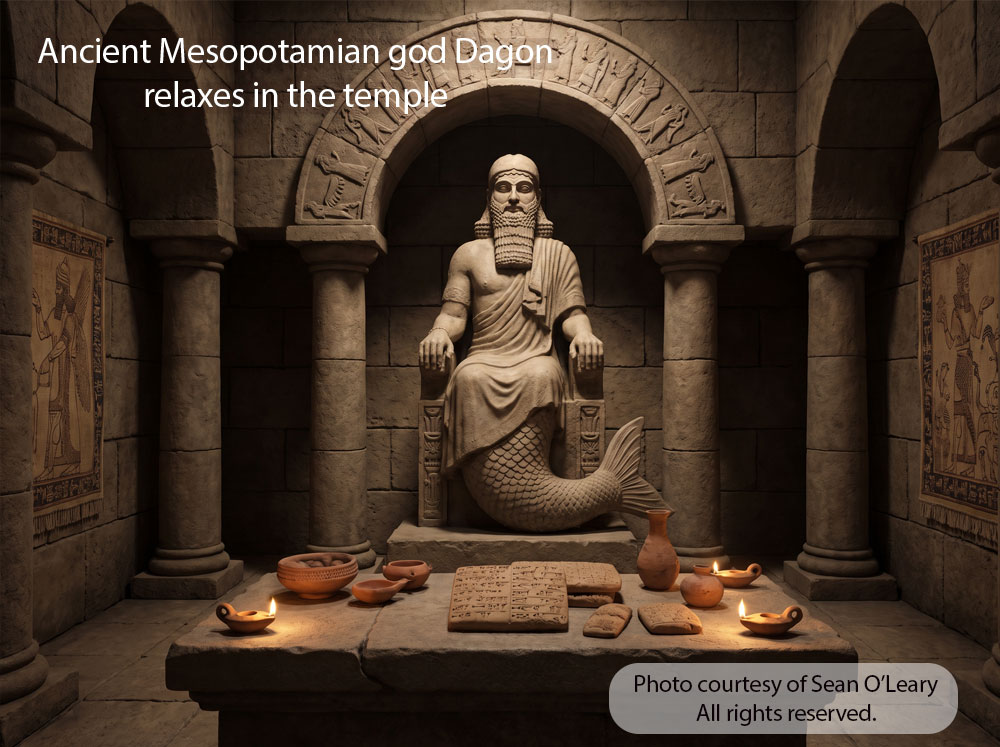
Ancient god Dagon before Samson opens a can of whup ass on him.
There is an indication that the Philistines forgot to keep him shaved, but that thread dies out without elaboration. The party line will be that the Lord grants him one final reprieve, allowing him to take revenge on his enemies.10 The Philistine elites throw a huge house party to perform sacrifices to their god Dagon Fish God and to celebrate the capture of Samson. He is brought inside and sat down between two pillars so that the revelers can taunt him.
He asks YHWH to return his strength one more time, a wish that is granted. Samson brings the house down on Dagon and a thousand or so partiers. We are left with the assurance that the event massacres even more Philistines than his previous totals, plus one god.
More on the historical Philistines vs the bad boys of the Hebrew Bible.

“And the Spirit of the Lord came upon him, and he went down to Ashkelon, and slew thirty men of them, and took their spoil.”
– Judges 14:19[KJV]
NOTES:
- The era of the Judges fills a two hundred year historical gap between the ostensible arrival of the millions of escaped slaves in about 1200 BCE and the inception of the monarchy about 1000 BCE. Judges were essentially warlords who ruled the unruly tribes via military prowess. The pattern was 1) Israelites sin 2) God gives them over to one of their many enemies 3) They find a new judge who throws out the enemy.
- This state of affairs is also complex, as the scripture points out parenthetically, But his father and his mother knew not that it was of the Lord, that he sought an occasion against the Philistines: for at that time the Philistines had dominion over Israel. Judges 14: 4 [KJV]So the plan was actually the Lord’s for the purpose of giving him an excuse to screw with the Philistines. To repeat a question asked regarding his control of Pharaoh: why does God need an excuse?
- One is sometimes tempted to ask what the point of symbolism is if no one understanding it – it’s worth entertaining the possibility that it’s all a ploy to keep the Lord’s middle management fully employed.
- Samson is assigned as “judge” over Israel during a twenty year period when the Israelites are described as “in the hands” of the Philistines. Although we are led to believe in the retelling that Samson was a champion of Israel, the text says he was picking fights with the Philistines over personal disputes. Tradition tells us there were twelve judges, most of whom fought pitched battles with enemies. Samson was far too busy chasing Philistine women.
- Nazirite: Some Israelites consecrated themselves to YHWH by undertaking vows to abstain from alcohol, grow their hair and not touch corpses no matter how strong the urge. Samson’s situation was a little different in that his parents made the commitment prior to his birth. This agreement takes place in the context of the standard barren women/angel annunciation scenario similar to Mary, Sarai and Elizabeth. These divine interventions raise the question: why didn’t God just make them fertile? Busy work for angels?
- The quote identifies Ashkelon, a Philistine coastal town.
- Considering the amount of time and effort required to catch three hundred foxes, a little thought would suggest he could have just lit the fires himself.
- This is not the gate to your exclusive subdivision. This is an large structure at the entrance of the fortified city of Gaza which would have been wide enough for carts and chariots to drive through. The doors would have been heavy enough to repel and attack, supported by very heavy posts and likely pivoted in stone supports. The gates of major fortifications had to be wide enough for chariots to drive through. It is forty miles from Gaza to Hebron.
- In a funny way, it’s easier to imagine a giant boat full of animals or sea waters parting than it is to picture what running off with a city gate might look like.
- In the context of the relentless biblical Philistine bashing, it’s easy to overlook what the text tells us: the Israelites may well be (god actually sells them to a couple of enemy nations in the book of Judges) under the thumb of the coastal peoples in some unspecified way, but every violent incident in these three tawdry chapters is initiated by Samson.