
A HUNGRY MESSIAH CURSES A FIG TREE AND KILLS IT
Genesis > Matthew 21:18-22 | Mark 11:13-14 > Luke
WARNING: Arboreal mistreatment, narrative contradictions
CONTEXT: ~ 30 CE This curious interlude takes place as Jesus is commuting between Jerusalem and Bethany, a near suburb of the capital city
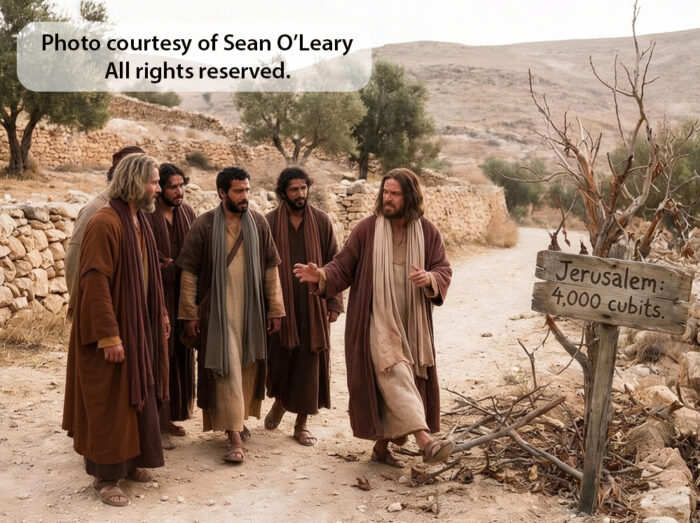
In the Gospels of Mark and Matthew we find similar (but not identical) accounts of Jesus cursing and killing a fig tree. He is hungry and the tree has no fruit for the Savior. In both versions, the Messiah and his disciples are returning to Jerusalem from Bethany, near the capital 1 On the way, Jesus approaches a fig tree with the expectation of grabbing a tasty fruit treat. Finding no figs on the tree, Jesus curses it, saying:
“May no one ever eat of your fruit again!”
Let’s be rigorously accurate here: Jesus doesn’t just curse the tree, he permanently condemns it so there is no hope of recovery. This is not a harmless lead-in to another parable (see below), it’s an expression of waspish anger.
The disciples continue on to Jerusalem, where the Messiah does the money changers in the temple bit.2
In the Matthew version the tree withers immediately upon being cursed and the disciples comment on it. They are a little surprised. But according to Mark, the boys discover the withered tree as they pass by on the way back to Bethany. It’s clearly the same story, but the writer has changed a small but significant detail.3
While this is a minor variation, both versions can’t be true. More importantly, is there a reason for the edit? Probably.
In Mark’s version, Peter notes the dead tree and mentions it to the boss. “Master, behold, the fig tree which thou cursedst is withered away.”
This is Jesus’s reply from the Gospel of Mark:
“And Jesus answering saith unto them, Have faith in God. For verily I say unto you, That whosoever shall say unto this mountain, Be thou removed, and be thou cast into the sea; and shall not doubt in his heart, but shall believe that those things which he saith shall come to pass; he shall have whatsoever he saith. Therefore I say unto you, What things soever ye desire, when ye pray, believe that ye receive them, and ye shall have them. And when ye stand praying, forgive, if ye have ought against any: that your Father also which is in heaven may forgive you your trespasses. But if ye do not forgive, neither will your Father which is in heaven forgive your trespasses.” – Mark 11: 22- 26
This ramble sounds great as far as it goes, but what does it have to do with the fig tree? Interestingly enough, in Matthew’s version the text has been changed to answer that very question.
“Jesus answered and said unto them, Verily I say unto you, If ye have faith, and doubt not, ye shall not only do this which is done to the fig tree, but also if ye shall say unto this mountain, Be thou removed, and be thou cast into the sea; it shall be done. And all things, whatsoever ye shall ask in prayer, believing, ye shall receive.” – Matthew 21: 21-22 [KJV]
Jesus’s edited reply in Matthew now focuses on the fig tree as an inspirational prop. If you believe strongly enough, you can kill a fig tree with your mind or move mountains. A range of possibilities.
There is an even more interesting discrepancy between the tale as told by Mark and the later version from Matthew. Mark tells us clearly that it was not fig season when the guys were heading to Jerusalem and therefore the tree literally could not bear fruit. Matthew leaves this detail out. It doesn’t seem like a big deal, but there is a difference attitude toward Jesus’s behavior. From Mark’s point of view, Jesus appears to have a hissy fit, in spite of the fact that the tree was out of season. In Matthew’s kinder version, he may not necessarily be aware of the arboreal realities.
Another reasonable question: why doesn’t the Son of God simply make some figs appear, similar to the loaves and fishes miracle?4 Apparently Jesus, who is generally presented as perfect in all things, prefers to throw out a curse in a fit of petulance.
If we accept Mark’s version, then Jesus was being unjust to the fig tree – if such a thing is possible. Mark’s gospel preceded Matthew’s, and is almost universally acknowledged as a source for Matthew and Luke (~70 CE).5 In other words, it looks as if the author of Matthew removed this minor but critical detail. If that is true, then why? The most reasonable hypothesis is that Mark’s story reflects poorly on the Messiah. Not only does he get mad at the fruit tree, he is expecting the impossible.6
Even in the bishop-approved canonical books of the New Testament, there are plenty of wacky stories about Jesus. When these puzzlers are encountered by believing theologians, the first instinct is to explain away such incidents as somehow integral to Jesus’s mission in the context of his dad’s plan.7 While this sort of confirmation bias is expected from God’s middle management, it nevertheless requires mental gymnastics to make sense of it for the ever receptive faithful.
One of the more effective gambits is to call these incidents parables.8 There are any number of attempts by theologians to make this incident into a parable about the spiritual and moral failures of the chosen people. Fun Bible Stories on the other hand is committed to reading only what is in the Bible and reaching reasonable explanations.
The fig tree interlude could have simply been a warning to the disciples not to screw up. Or it could have been a case of the Messiah being in a bad mood.
After all, he’s only human.

“No man eat fruit of thee hereafter for ever.”
Mark 11: 14 [KJV]
NOTES:
- This is the same chapter in which Jesus rides triumphantly into Jerusalem on a donkey (Gospel of John), or a colt (Gospels of Mark and Luke) or both (Gospel of Matthew) depending on which book you reference. When this story is told as part of the crucifixion/Easter sequence, it is given far more emphasis than it gets in New Testament pages. What is virtually never mentioned is that the big Hosanna parade, Jesus and the boys leave town and return to Bethany. He enters Jerusalem with great fanfare, does some sightseeing and walks around the Temple. Then they walk back the few miles to Bethany, undoubtedly for less expensive lodgings. The Temple referenced is the campus of the Second Temple, not some sort of large church. This urban complex was the economic engine of the city and province and the seat of power..
- The money changers story provides the best hint we have as to the political underpinnings of the Jesus story. The Temple hierarchy elite was colluding with the Roman Empire, enriching themselves at the expense of the peasantry. One of the ways they did this was to require the country folk to change their currency into Temple shekels in order to buy approved sacrificial livestock from the priests. The historic Joshua ben Joseph (Jesus) was likely a revolutionary leader from the hills.
- Although Matthew occurs first in the Bible, the material we identify as “Mark” was written earlier. Scholars are virtually unified in describing Mark as a source for both Matthew and Luke.
- Perhaps even Jesus is unlikely to waste a miracle forcing a tree to fruit out of season. Is there a miracle quota? Only God knows.
- The fig tree incident does not appear in Luke of John).
- This edit follows a similar pattern seen in the story of Jesus and the 2000 pigs. In both cases, Mark’s original version has been cleaned up.
- Scholars vs Theologians: Scholars investigate all relevant data to arrive at a factual truth and modifies their conclusions as new evidence emerges. By contrast, theologians pursue information that confirms their spiritual worldview, twisting data to confirm that they believe.
- Not unlike Buddhist koans.
.