
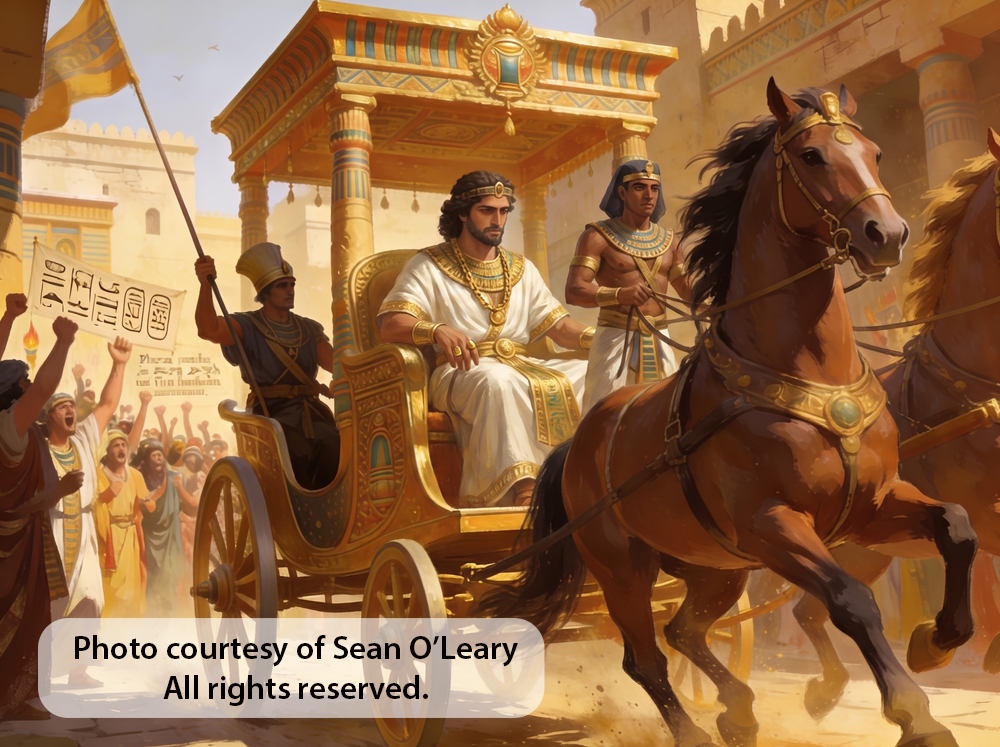
JOSEPH TURNS THE POPULATION OF EGYPT INTO SHARECROPPERS…AND THEY THANK HIM
Genesis 37 – 48 > Exodus
WARNING: Kidnapping, attempted adultery, seven years of drought, exploitive public policy
CONTEXT: ~ 1750 BCE Once sold into slavery by his brothers, Jacob’s son Joseph is now Viceroy of Egypt during the Middle Kingdom.
SUMMARY
The story of Joseph in Egypt is another family friendly Bible story, with genuinely moving emotional moments that a good Sunday School storyteller can milk to expedite the faith of little Christians. The resonance of the tale over the years is largely attributable to the personalities and family drama on display. But as is the case with a lot of scripture, there is a disturbing element within the narrative that is widely ignored: In the process of saving the Egyptian population from a seven year famine, Joseph expropriates their land, money and cattle for Pharaoh. He proceeds to create a serf class, who are permitted to work their former land as long as the king and his boy viceroy get a cut. The people are most grateful.
Let’s see how this comes about.
At the beginning of Genesis 37, Joseph is pretty much of a tone deaf little jerk. As Jacob’s favorite son,1 young Joseph is quite full of himself, ratting out his older brothers and managing to make his siblings angry enough that they sell him as a slave to traveling Midianites.2
Inserted in the middle of this tale is Genesis 38, the very strange story of Judah and Tamar, a forebear of the Christian Messiah. We then continue with the Joseph cycle.
Nevertheless, God has given him so much obvious administrative talent that he becomes head of Captain Potiphar’s household slaves. Not only is Joseph a first class facility manager, he also a stud muffin.3
“And Yosef was yafeh to’ar (well built) and yafeh mareh (good looking)”. – Gen. 39:6 [OJB] Orthodox Jewish Bible
This fact is not wasted on Potiphar’s horny wife, who pursues him for sex. Joe rejects her because he is a righteous little prig, at which point she accused him of rape. The Israelite slave ends up in jail where he again demonstrates so much potential that he becomes a trustee of the warden.4 As was the case with Potiphar’s household, things go so well at the prison that the warden lets Joseph run it as he sees fit.5
Eventually his dream interpretation gifts earn him the attention of Pharaoh. The king has dreamt of seven fat cows who are eaten by seven thin cows, then seven fat sheaves of grain are eaten by seven thin sheaves. Joseph’s ability to see the future through dreams may well be the gift of YHWH, but the meaning of these particular visions is not exactly mysterious. Joseph tells Pharaoh that God6 is signaling seven years of plenty followed by seven years of drought. Right on the spot, Pharaoh decides to make young Joe viceroy of all Egypt, specifically in charge of agriculture. He becomes a prince of Egypt and is married to Asenath the daughter of Potipherah, high priest of On.7 The Israelite lad rides in the realm’s number two chariot and the people have to bow down to him.
Here’s where the really weird stuff happens. The seven years of boom harvest come about as predicted. Joseph confiscates twenty percent of the corn and stores it in the cities. When the lean times come, he sells the grain back to the farmers. Of course, it was their grain in the first place, so this is a nice economic model for the Pharaoh and his boy viceroy.
There is a nice family interlude here in which Joseph pranks his brothers, then forgives them for selling him to the Midianites. He gets to introduce his family to Pharaoh, who resettles Jacob in the high priced district of the Nile delta.8 The Joseph narrative sets up the Exodus story four or so centuries in the future. During the interim, the scriptures go dormant and we don’t hear from YHWH at all. The biblical timeline matchup would be about 1700 to 1300 BCE.
And that’s where most Bible classes end the narrative. But as is the case with so many Sunday School stories, there is a lot more in the Genesis account, and it is not wonderful. In Genesis 47, the famine continues, resulting in Joseph enslaving the entire population of Egypt.9
After the Israelites are relocated to Goshen, the famine gets worse for the Egyptians, but there is no indication that the seven year food emergency affects the Israelites in their fertile and apparently drought-free neighborhood.. This topic is not addressed in the narrative.
“And there was no bread in all the land; for the famine was very sore, so that the land of Egypt and all the land of Canaan fainted by reason of the famine.” – Gen. 47:13
Joseph takes all the money in Egypt in payment for the grain he previously expropriated from the agricultural sector. When the money runs out the next year, he takes their cattle in payment for food.10
“And Joseph said, Give your cattle; and I will give you for your cattle, if money fail.” – Gen. 47:6 [KJV]
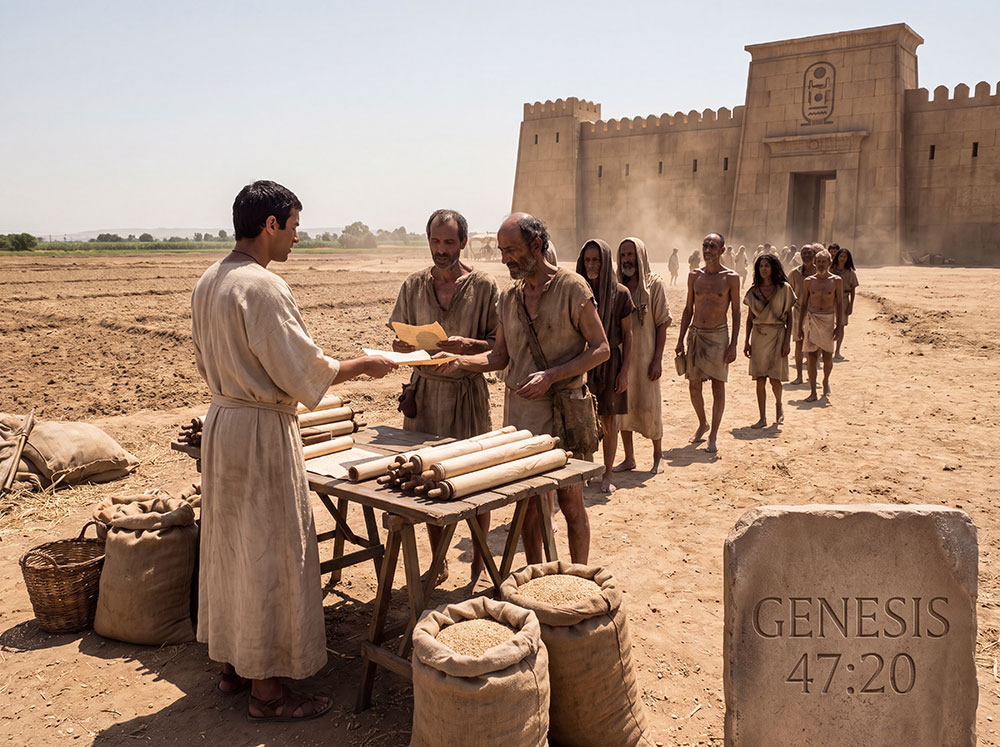
As the harvests continue to fail, Joseph takes the people’s land, but generously allows them to live on it and raise crops, as long as they pay Pharaoh 20% tax on the land he stole from his people. Viceroy Joe relocates the populace as he sees fit.
“And Joseph bought all the land of Egypt for Pharaoh; for the Egyptians sold every man his field, because the famine prevailed over them: so the land became Pharaoh’s. Then Joseph said unto the people, Behold, I have bought you this day and your land for Pharaoh: lo, here is seed for you, and ye shall sow the land.” – Gen. 47:20 – 23 [KJV]
Now all this takes place after Jacob’s family has been given the region of Goshen. No more mention of that point is made, so we must conclude that the Israelites appear to be immune from confiscation. The famine section ends abruptly.
According to Joseph, this was all part of an extended plan that brought the Jacob/Israel family down Egypt so they wouldn’t starve. And it turns out to be a four hundred year plan, which involves future enslavement for Jacob’s growing clan and death for millions.11
All for the sake of a great story. You go, God!

“And Joseph bought all the land of Egypt for Pharaoh; for the Egyptians sold every man his field, because the famine prevailed over them: so the land became Pharaoh’s.”
– Genesis 47:20 [KJV]
NOTES:
- Joseph and his younger brother Benjamin are the only two sons of Jacob’s wife Rachel, the hot younger sister of the prolific baby machine Leah. Jacob had to work an extra seven years to purchase Rachel after his uncle tricked him.
- The Midianites are also descendants of Abraham through his second wife, Keturah. This branch of the tribe is Arabic. When Moses flees Egypt four hundred years later, he ends up in Midian and marries Zipporah, daughter of a Midianite priest. Although the relationship is unremarked in scripture, it could easily be conjectured that Moses may have known that the Midianites were “cousins” when he was on the run from the law. In Exodus, we soon lose track of Moses’s Arabic children and their descendants; his first wife returns to her father and we have no further news of her fate.
- Having grown up in a sheep camp, it isn’t clear how Joseph would have acquired such skills and knowledge.
- This all fun for the plot, but Joseph would more likely have been tortured and executed for his crime.
- The text tells us several times that YHWH is protecting Joseph – the question being, why allow bad things to happen in the first place? Why does our intermittently loving god bring about horrible events? One is told as a child that our divine Father is testing us. As an adult, is one permitted to ask how come? Wait wait. We can’t know the mind of God.
- Pharaoh and Egypt are immersed in a vast complex culture based on hundreds of deities. It is typical of the myopic perspective of biblical narrative that Pharaoh somehow buys into the agency of a minor desert deity he is unlikely to be familiar with.
- One wonders whether YHWH was concerned about this development. Considering his frequent, violent insistence on being either the only god or (sometimes) the most powerful god, why would he condone Joseph marrying into the family of a pagan priest? His two sons – who represent two of the thirteen tribes – are half-Egyptian.
- Although there are no Egyptian references to the place, Goshen is assumed to be northeastern region of the Nile delta. Genesis gives us a number of 70 people who moved n down with the Patriarch. When Exodus picks up the story about four hundred years later, the number of Israelites should have been in the in the range of ten million giving normal breeding habits over ten generations.
- There is a little irony here that is seldom commented upon. Joseph enslaves the population of Egypt, which is millions of people. Four hundred or so years later, the Israelites are slaves but with a population that exceeds the estimated citizenry during this era. What happened in the interim?
- Looking ahead to Exodus, we will encounter a similar conundrum. The Egyptians apparently have plenty of cattle, as do the fleeing Israelites. Why don’t the Egyptians eat the cattle, and why do the Israelites need manna and quail, when they have all of their livestock.
- When we leave the story, Joseph is an aristocrat of the Egyptian royal regime and his children are privileged members of the elite. We do know that he is embalmed, mummified and buried in Egypt. We never learn what happened to the family between the end of Genesis and the beginning of Exodus
.