
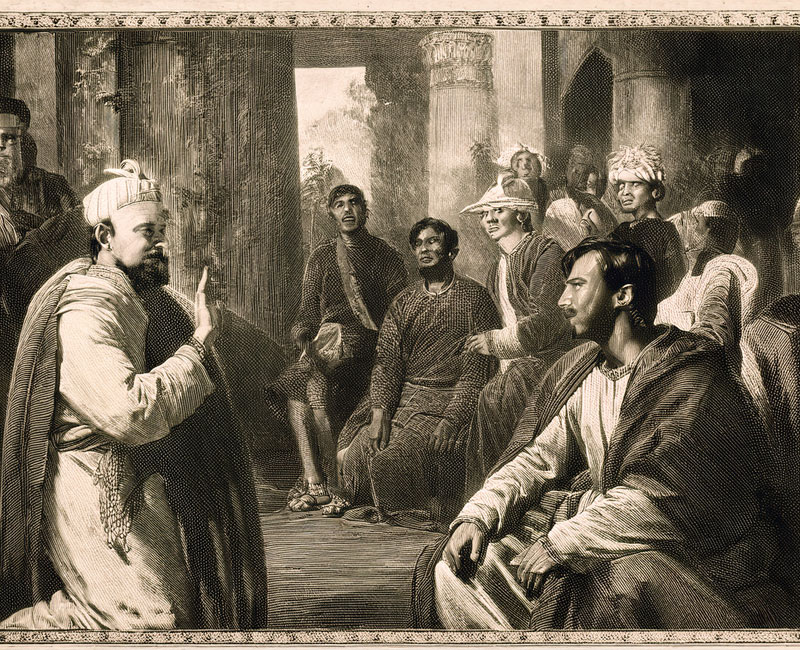
JESUS TALKS ROYAL NEWLYWEDS OUT OF CONSUMATING THEIR MARRIAGE.
Acts of Thomas 1 – 13
WARNING: Mauling, violent death, sketchy geography, sibling betrayal
CONTEXT: Imagine you are a newlywed ready to consummate your marriage, but instead you find Jesus sitting on the nuptial bed ready to explain the evils of sex and children.
As this extensive book opens, Jesus is in the process of selling his twin brother (Judas) Thomas into slavery without his knowledge…and we’re off and running. Although this rollicking yarn resembles a compendium of holy Sinbad the Sailor-like adventure tales, there is a certain amount of historical legitimacy to the legend that Thomas (or someone like Thomas) carried the Christian message all the way to India. Today, hundreds of thousands of Indians practice a brand of the religion that is a bit of a variation on the main cult. Not shockingly, they consider their version of Christianity to be the legitimate reading of the scripture; all others are in error.
In this article, we only have space to take a look at the highlights of this meandering gospel:
- Jesus tricks his brother the apostle into going to India by selling him as a slave
- The savior joins a newlywed couple in their chambers and convinces them to take a vow of chastity. He delivers a rant on the fundamentally nasty nature of children.
- We experience more than one talking donkey in this epic, including one related to Balaam’s talking ass (see)
- Thomas is executed for convincing a king’s wife to stop having sex
As you read, continue to bear this in mind: while this particular gospel did not ultimately “make the cut” for the official literary smorgasbord we now call the Bible1, the events described are no more bizarre than anything in the “real” New Testament. The selection of the books that make up the approved Christian scriptures was entirely arbitrary.
Setting Sail
As the story begins, the apostles are dividing up the world among themselves, assigning locations for proselytizing the good news.2 Judas Thomas, Jesus’s twin brother is assigned to India, but he refuses the gig.3 We don’t know what his problem with Indians is, but he has one for sure.
We are introduced to an Indian agent named Abbanes, who has journeyed to Jerusalem4 to hire a carpenter on behalf of King Gudnaphar.5 (this is about 3,000 miles overland) Jesus chances upon Abbanes in the marketplace and offers to sell him a carpenter/slave for “three litrae of silver unstamped.”6 The Messiah doesn’t mention to Thomas that he is about to be enslaved, but the future saint decides to go along with the plan at this point. He sets sail for India.7
From Jerusalem to any point in India by sea would require a circumnavigation of Africa, a distance of about 18,000 miles.
Thomas and Abbanes arrive in the city of Andrapolis, Egypt.8 Just as they disembark, the king of the city is throwing a huge wedding party for his daughter. All are invited. Thomas and his master attend, but it is clear that the dyspeptic apostle is not having a good time. He sings a passive aggressive poem of sorts, which could be construed as insulting to the bride. Providentially, he sings it in Hebrew, so the only other person who understands the song is the Jewish flute-girl. She falls in love with him because he is so good looking. She sits near to him waiting to be noticed, but Thomas ignores her, counting the minutes until he can leave.
Unfortunately, one of the king’s cup bearers is suspicious of the song, so he assaults Thomas. Shortly afterwards, he is killed most unpleasantly by a lion, which is unaccountably hanging around a well outside the palace. The lion mauls him so badly that only body part remaining is his right hand. A stray dog brings it into the wedding party.
“But the cup-bearer that had buffeted him went down to the well to draw water; and there chanced to be a lion there, and it slew him and left him lying in that place, having torn his limbs in pieces, and forthwith dogs seized his members, and among them one black dog holding his right hand in his mouth bare it into the place of the banquet.
And all when they saw it were amazed and inquired which of them it was that was missing. And when it became manifest that it was the hand of the cup-bearer which had smitten the apostle, the flute-girl brake her flute and cast it away and went and sat down at the apostle’s feet, saying: “This is either a god or an apostle of God, for I heard him say in the Hebrew tongue: ‘I shall now see the hand that hath smitten me dragged by dogs,’ which thing ye also have now beheld; for as he said, so hath it come about. And some believed her, and some not.”
– Acts of Thomas 1:8-9.
Yeah. Don’t mess with St. Thomas.
Any reasonable person would conclude that the sudden, violent death of the cup bearer must be attributable to the personal intervention of a deity upon whose good side it is better to be.9
The flute girl explains the message of Thomas’s brother to the king, who agrees to listen to Thomas proselytize. The king then asks Jesus’s representative to pray for his only daughter on her wedding night.
Jesus Delivers a Surprise Celibacy Lecture
When the bride and groom arrive in the bridal chamber, Jesus is there in the guise of Thomas. He not only converts the youngsters to Christianity, he convinces them that all sex – even marital – is sinful. In fact it is downright disgusting. There are many other downsides to sex, in particular children. He paints a grim picture for the young bride and groom:
“Remember, my children, what my brother spake unto you and what he delivered before you: and know this, that if ye abstain from this foul intercourse, ye become holy temples, pure, being quit of impulses and pains, seen and unseen, and ye will acquire no cares of life or of children, whose end is destruction: and if indeed ye get many children, for their sakes ye become grasping and covetous, stripping orphans and overreaching widows, and by so doing subject yourselves to grievous punishments. For the more part of children become useless oppressed of devils, some openly and some invisibly, for they become either lunatic or half withered or blind or deaf or dumb or paralytic or foolish; and if they be sound, again they will be vain, doing useless or abominable acts, for they will be caught either in adultery or murder or theft or fornication, and by all these will ye be afflicted.” – Acts of Thomas 1:12.9
Presented with this information, the bride and groom publicly announce they will abstain from sex in their marriage.10
If all humanity were to embrace celibacy, the species would die off rather quickly,
leaving the creator of the universe alone with no one to piss him off.
At first the king is quite angry about his daughter committing to a sex-free marriage, the primary function of a princess being to breed for the royal family. He sends his officers to find Thomas, who has already set sail leaving the lovelorn flute-girl heartbroken. However, she does help the young newlyweds convert the King to celibacy inflected Christianity.
Thomas has other adventures once he arrives in India. He so impresses King Gundaphorus with his knowledge of construction techniques that the king immediately charges him with building a palace. Rather than build the palace however, the erratic saint instead distributes the building funds to charity as he wanders about proselytizing about the upstart regional God who is becoming all the rage. Worse, he continues to lie to the king about progress in order to keep the bling flowing. When Gundaphorus finds out, he imprisons Thomas and Abbanes. The king expends considerable time contemplating how he will execute Thomas, but when the king’s brother Gad dies, angels fly him up to heaven, where he discovers that Thomas has actually built the king a palace in the realms of the afterlife. Gad is sent back to earth, and discloses the miracle to Gundaphorus, whereupon both king and brother are converted.
Thomas and his companions discover a young man who has been slain by a wicked serpent. At the insistence of Thomas, the snake reveals his demonic identity. Thomas then requires the serpent to suck his own poison out of the dead youth, which results in the death of the serpent and the resurrection of the boy. The act closes with songs of praise and sermons on the benefits of the encratic life.
A donkey approaches Thomas and asks to bear him into the city. At the request of Thomas, the donkey reveals an unlikely lineage which includes Balaam’s talking ass (Numbers 22:21-38) and the donkey that bore Jesus into Jerusalem. After Thomas rides the beast into the city, it dies, having fulfilled its purpose.
Thomas meets a young man whose hands shrivels up when he takes the Eucharist. We learn that this happened because he had murdered a woman who refused to forsake sexual activity. Thomas causes the woman to return from the grave, whereupon she recounts the horrors of hell.11
He then proceeds to perform a whole series of random exorcisms while continually promoting his anti-sex agenda.12 This ultimately gets him into serious trouble when he convinces Mygdonia, the wife of a nobleman, to embrace the celibate lifestyle. 13 King Misdaeus throws Thomas into prison and sentences him to death, meanwhile sending his wife to talk some some sense into Mygdonia. The plan backfires when the wife also goes chaste. What there is of a plot unravels at this point; the gospel ends with Thomas’s execution, followed by any number of visitations and magic stunts. The good news is that eventually everyone is brought over to Jesus’s side.

Imagine you are a newlywed ready to consummate your marriage, but instead you find Jesus sitting on the nuptial bed ready to explain the evils of sex and children.
NOTES:
- The word “Bible” comes from the Greek word biblia, meaning “book.” This term originated from Biblos, a Phoenician city known for exporting papyrus, which was used to make early books. The plural bibliaeventually came to refer to the “holy books” and the collection of sacred texts, evolving into the Latin biblia, then the Old French bible, and finally the English word “Bible.”
- A recurring question is why the creator of the universe needs to enlist the aid of agents to spread his word and especially, to ‘splain his holy literature.
- The debate as to whether Thomas and Jesus were twins is all over the map. In the Acts of Thomas they are explicitly described that way, but it is hard to see how that would be possible if Mary were a permanent virgin. The topic of the exact nature of Mary’s persistent virginity continues to be of the utmost importance for people who think it is a critical issue vis a vis one’s personal salvation. Being on the wrong side of the debate could cost you your life in the early stages of the Christian takeover.
- The nearest border with India would be about 3,000 miles away overland through desert, so one wonders if perhaps there were one or more carpenters a little closer.
- King Gundaphorus is a historical figure, founder of the Indio-Parthian empire in northwestern India and Pakistan.
- A litra was an ancient unit of weight, roughly equivalent to 12.5 ounces of silver. The term “unstamped” indicates the silver was not officially marked or tested for purity.
- The story begins in Jerusalem, which is not located on any body of water. Nevertheless, we will assume he embarks from a port on the southeastern Mediterranean coast. This is really the only option, because the first stop in the story is in Egypt, traveling west, away from India. From there to any point in India by sea would require a circumnavigation of Africa, a distance of about 18,000 miles.
- Kherbeta, near Alexandria in modern Egypt.
- As a study in instant scriptural contradiction, note that in the next passage, Thomas speaks of the Lord’s compassion.
- In particular, the topic of celibacy is problematic, reflecting as it does the entirely unhealthy Christian obsession of with sex. That fixation in turn is a source of the embedded misogyny of the Abrahamic faiths. The history of the Catholic Church’s bizarre preoccupation with celibacy in the priesthood – which did not become “law” for a thousand years – is another case of extravagant scripture twisting.
- This description of the underworld is nearly word for word for a similar passage in the non-canonical Gospel of Peter.
- It is a matter of some concern whether the Church theologians actually took their cues on celibacy from the Lord God himself or made it up to correspond with their own troubled psyches.
- If all humanity were to embrace celibacy, the species would die off rather quickly, leaving the creator of the universe alone with no one to piss him off.
.