The Stuff They Forgot To Read to You
A de-programming service
A Virgin Sacrifice to the Lord
A WARLORD BARBEQUES HIS ONLY DAUGHTER TO THANK YHWH FOR VICTORY
JUDGES 11 Joshua > Judges > Ruth
WARNING: Human sacrifice, unintended consequences
CONTEXT: ~ 1230 BCE to 1020 BCE The Book of Judges occupies an interim time frame between the arrival of the Israelites in Canaan and the installation of the monarchy. It also contains some of the most disturbing and violent episodes in the Bible. Speaking of book banning initiatives in America, one wonders why any family values advocate would want their impressionable child exposed to the graphic violence and sexuality of the Bible – especially the Book of Judges.1 In particular, let’s take a look at Judges 11, in which the warlord Jephthah sacrifices his teen daughter to thank YHWH for victory over the evil Ammonites.
STORY SUMMARY: On the way to battling the Ammonites2 Jephthah the Gileadite3 vows to sacrifice whatever or whomever he first encounters after the victory.
“And Jephthah vowed a vow unto the Lord, and said, If thou shalt without fail deliver the children of Ammon into mine hands, Then it shall be, that whatsoever cometh forth of the doors of my house to meet me, when I return in peace from the children of Ammon, shall surely be the Lord’s, and I will offer it up for a burnt offering.””– Judges 11:30-31 [KJV]
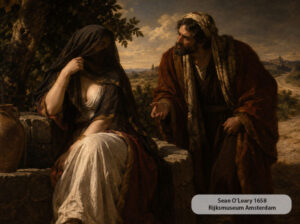
The good news is that Jephthah wins the battle, wiping out twenty towns in the process; the bad news is when he returns home, his unnamed daughter dances out the door playing her tambourine in celebration of his victory.
Jephthah abruptly realizes that he has failed to thoroughly consider the possible consequences of his vow to the Lord. The mighty warrior rends his clothes. Nevertheless, after granting his only child a few months to hang out with her friends he sacrifices her as promised. In order to assure Fun Bible Stories readers experience the holy scriptures are as realistically as possible, the process of sacrifice would involve binding the girl to an altar, slaughtering her like a farm animal and then burning her body.4 The nature of that task is described in detail in Exodus and Leviticus.
In the text,YHWH has nothing to say about the murder of an innocent one way or the other, and he certainly does nothing doesn’t prevent the filicide.5
Burning the girl: an old school parent willing to make sacrifices.
A fascinating offshoot of this story is the effort by Bible apologists to claim Jephthah didn’t necessarily fulfill his horrifying promise. The rhetoric of these arguments is absurdly deceptive, suggesting that the text doesn’t clearly describe how he barbecues his kid. Or maybe YHWH stopped the killing and someone forgot to write it down. Or it could be a mistranslation, a favorite of biblical pseudo scholars. The problem this narrative poses to the inerrancy belief system is obvious.6 Theologians of the inerrancy school understand that this kind of gas lighting works because few of their flock will grab their good book to verify the apologist argument. As is the case with so much biblical pseudo scholarship, the objective is to simultaneously support the literal truth of the scripture while explaining why the text doesn’t say what it says.
Here is what the passage says: “And it came to pass at the end of two months, that she returned unto her father, who did with her according to his vow which he had vowed: and she knew no man. And it was a custom in Israel, that the daughters of Israel went yearly to lament the daughter of Jephthah the Gileadite four days in a year.” – Judges 11:40 [KJV]
That excerpt is from the King James Version [KJV], but every translation says the same thing with little variation: Jephthah made good on his vow, which was to sacrifice his daughter. Along with additional biblical context and from other sources, it is clear that human sacrifice was not as alarming to the ancients as it is to the modern reader. The accounts are matter of fact in tone. The practice of offering burnt children to the gods is seen throughout the Bible, through multiple lenses. One unique Christian apologetics argument claims that Jephthah gave his daughter into service to the Lord instead of slaughtering her. That’s not what is says. Not to put too fine a point on it, but the Bible says he vowed to offer her up as a burnt offering and that he did so. You don’t have to be a Christian to know how to read.
___________________ NOTES__________________
1. Old Testament “judges” were not judicial officials but rather de facto rulers more akin to warlords. The roughly two hundred year period spans the time after the death of Joshua (1230 BCE) to the coronation of King Saul (1020 BCE). In terms of historical accuracy, this time period is the fulcrum between the legend that precedes it and actual events beginning with the reign of David. King David is real; Joshua and Saul are less likely to be.
2. Ammonites: Canaanite types resistant to wandering Israelites taking over their land. While YHWH bestows Palestine to Abraham and his heirs several times over many centuries, there is no indication he informed the indigenous inhabitants. Think of them as just another indigenous people wiped out by YHWH’s hordes. This established a pattern that white Europeans deployed to great effect when usurping the Western hemisphere, using the same scripture. It is worth noting that in the previous passage, we are told that God himself sold the Israelites into the hands of the Philistines and Ammonites. Very few of the events depicted in Judges are supported by archeology or history.
3. Gileadite: Jephthah is introduced from the beginning as a sketchy guy, an outlaw of sorts who heads a band of scoundrels. (This turns out to be case with several of the judges, especially Samson.) Not only is his mother is described as a prostitute, but he has been forced from his home by his brothers due to his illegitimate birth.
4. An additional issue is the fact that Jephthah is neither a priest nor a Levite and is therefore unqualified to make sacrifices, human or otherwise. In the Torah, the Lord provides extremely detailed sacrificial protocol, which, if followed to the letter, would render our description of the bloody ritual even more disturbing. Furthermore, God takes offerings to himself very seriously. The price of messing up even a small detail is sudden death. For example, Lev. 10. describes how a pair of unfortunate losers Nadab and Abihu (sons of High Priest Aaron) used the “wrong fire” for a sacrifice, aggravating the Lord of the Universe to the point that he burns them up. So why there are no consequences for Jephthah is yet another Bible mystery.
5. Compare this scenario to the famous divine test of Abraham in Gen. 22. whois willing to sacrifice Isaac until YHWH calls it off. See other child sacrifice in Jeremiah 19:5-6 and 2 Kings 3:26–27. When giving the law in Exodus 13:2, God marks the first born as his. Subsequent chapters offer to redeem the kid for five shekels. It is not clear if this is optional, or what happens if one is a little short of shekels.6. The inerrancy crowd maintains that every word and event in the Bible is true. Suffice to say internal anomalies alone belie that position (let alone common sense). There are also subsets who believe that only one particular edition of the Bible is true, the most popular of which is the King James. That particular version had been through at least four translations before King James commissioned it for his own agenda.