
MAGICAL TREE BRANCHES: BEST PRACTICE SHEEP BREEDING WITH THE HELP OF THE LORD.
Genesis 30 – 31 > Exodus
WARNING: Magical sheep breeding
CONTEXT: ~ 1700 BCE Abraham’s grandson Jacob continues to wander around the promised land, demonstrating divine backing for his animal husbandry skills
Who needs a Father-in-Law Like Laban the Syrian
Genesis 31 delivers an inspiring scripture snippet that fits seamlessly into any upbeat sermon. Sadly (like Springsteen’s “Born in the USA”), it’s actual contextual meaning is quite the opposite of most people think it means (including, apparently, members of God’s middle management.
Particularly in Genesis, we are treated to multiple installments of Jacob’s bitter disagreements with his father-in-law / uncle “Laban the Syrian,” all of which involve either livestock or his daughters (both valuable commodities). Indeed, a significant portion of the Torah concerns itself with livestock management and disputes arising from that vocation.
It is notable that Laban is referenced as “the Syrian.” This means that Rebecca, Jacob’s mother (Laban’s sister), is also a Syrian, and therefore Jacob – who will literally give the Israelites his name – is half Syrian + half Iraqi = 100% Arabic. This is strange in that he is expected to acquire his wives from his “own people” rather than the Canaanites, but his people are called out as specifically non-Hebrew. Ultimately, since we are dealing with legend and not history, it’s all a game of nomenclature. Nevertheless, I do feel the need to point out that no one in the whole running patriarchal narrative at this point is “Jewish.” (See Jesus’s Shocking Lineage, Part 1)
Earlier in this saga, Laban tricked Jacob into marrying his ugly daughter Leah. Jacob then has to work another seven years to get to hot Rachel. Laban also tried to cheat Jacob by reducing his wages.
Magical Tree Branches: Best Practice Sheep Breeding With the Help of the Lord
Next (in Gen. 30) we are onlookers to a curious sheep breeding incident, in which Jacob deploys magic to thwart Laban with a regressive sheep breeding scheme. In order to persuade Laban to let him depart, Jacob offers to take the speckled, streaked or colored goats and lambs with him, leaving the white sheep for his father-in-law. The imperfect sheep are understood to be less robust for breeding – unless, of course you have YHWH on your farm team. (The narrative scenario is slightly more complicated, but the takeaway is that Laban is greedy and Jacob is blessed by the god of his fathers).
Jacob uses three types of tree branches to tilt the breeding results his way. He finds “rods of green poplar and of the almond and chestnut trees, peeled white strips in them, and exposed the white which was in the rods.” This entices the speckled flocks to increase their fertility. To expedite this process, he selectively positions the stripped branches in the watering troughs. Apparently, the sheep like to mate when they come to drink, hence the magic branches in the drinking troughs. near the stronger females when they are in heat.
God comes to Jacob in a vision to let him know he was behind the unusual breeding process. The net result is that Jacob once again increases his own wealth. Did he trick his father-in-law or simply have divine given knowledge of a neat bit of agricultural sorcery that makes speckled sheep breed efficiently? There is of course the background element of Jacob’s inherently deceptive nature in play here: Indeed, an objective analysis of Jacob’s character suggests that his ability as a sheep manager far exceeds any other positive character attributes.
The Bad Blood Continues
Genesis 31 opens with Jacob sneaking off to Canaan with his family and flocks. He has finally had enough of his no good father-in-law and constant troubles with speckled sheep, fake brides and shorted wages. But soon, Laban and his thuggish home boys catch up with the escaping throng. The Syrian begins complaining about Jacob’s departure. He claims his feelings are hurt because he would have wanted to throw a nice going away party. He whines that Jacob has taken away the precious daughters that Laban sold him as well as all the livestock that is rightfully his.
After an incident involving stolen goods and Rachel’s menstrual period (see Rachel’s Menstrual Cycle Saves the Day), Laban and Jacob air the entire history of their grievances going back two decades. Jacob points out that he had to work fourteen years to acquire the two women and another six for the sheep.2
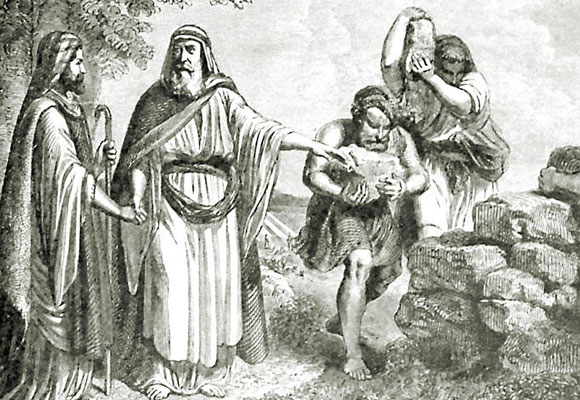
Ultimately a pillar is raised and heaped with stones (although both men claim to have set it up and each gives it a different name) to act as a boundary between the two groups. The post is to serve as a marker for a new treaty.
“And Laban said to Jacob, Behold this heap, and behold this pillar, which I have cast betwixt me and thee: This heap be witness, and this pillar be witness, that I will not pass over this heap to thee, and that thou shalt not pass over this heap and this pillar unto me, for harm.” – Gen. 31:48 [KJV]
The agreement is simple: you stay on your side and I’ll stay on mine. The famous but misinterpreted quote occurs at this point:
“May the Lord watch between me and thee, while we are absent one from another.”– Gen. 31:49 [KJV]
But this is not intended as a rapprochement or feelgood farewell. These guys simply don’t trust each other, so they call in El Shaddai as a divine referee. I don’t trust you, so I need God to keep an eye on you. Stay on your side of the line. I’ll stay on mine
At this point we are glad to leave behind the utterly tiresome Laban for good, wondering to some degree what was the point of this entire cycle in terms of our spiritual growth?

Jacob points out that he had to work fourteen years to acquire the two women plus another six for the sheep.
– Gen 31
NOTES:
- His father Isaac is the son of two Iraqis: Abram and Sarai.
- His own character flaws aside, he has a point here. .
.