SOMETIMES, YOU NEED A SPONTANEOUS HUMAN BARBEQUE TO TURN THINGS AROUND
1 Kings > 2 Kings 3 > 1 Chronicles
WARNING: Human sacrifice, a vast lake of blood
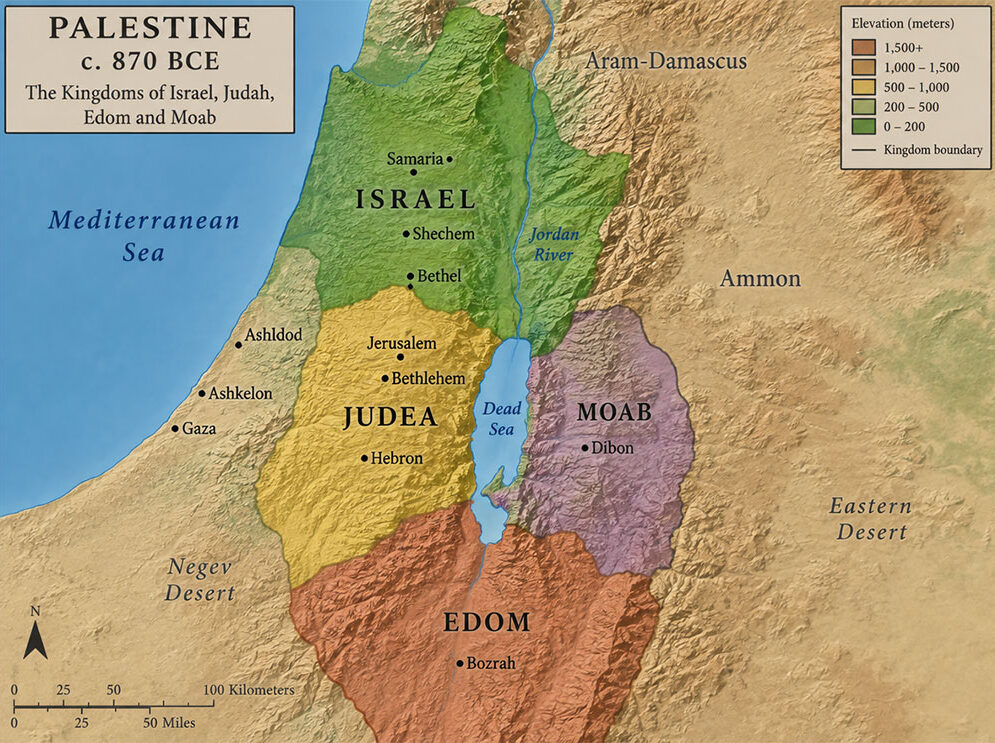
CONTEXT: ~ 870 BCE These events are set in the declining days of the Kingdom of Israel during a war among the Judeans, Israelites, Edomites1 and Moabites.2
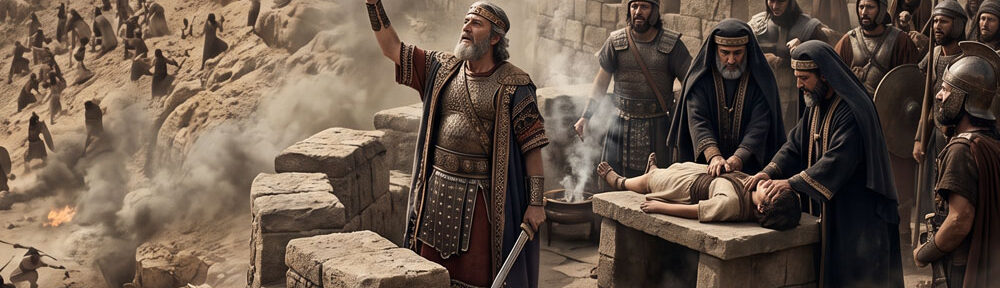
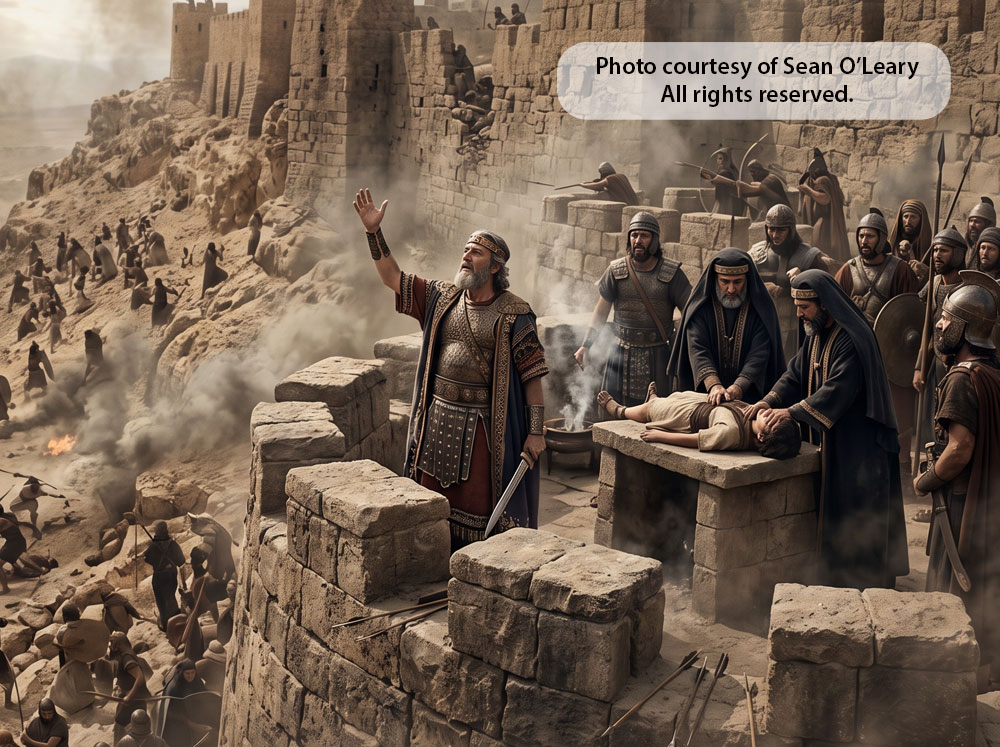
Near the conclusion of this bizarre narrative about a regional war involving four very small city states, the King of Moab has been defeated by the combined armies of Judea, Israel and Edom. With the rest of Moab destroyed and stones heaped upon the fields, King Mesha3 is holed up in his capital city, about to be wiped out by an Israelite//Judean/Edomite4 military force armed with slings. The only thing the king can think to do is publicly sacrifice his son and heir on the walls of the city. When the Israelites see this, they go home.
The reaction to this horrific event is ambiguous and depends on the translation you read. The iconic King James Version [KJV] 5 tells us this:
“Then he took his eldest son that should have reigned in his stead, and offered him for a burnt offering upon the wall. And there was great indignation against Israel: and they departed from him, and returned to their own land.” – 2 Kings 3:27 ] KJV]
But the Common English Bible [CEB] reads as follows:
“He then grabbed his oldest son who was to be the next king and sacrificed him as an offering on the city wall. The Israelite troops were so horrified that they left the city and went back home.” – 2 Kings 3:27 [CEB]
The King James Version strongly implies that public opinion turned against Israel, causing them to leave the battlefield and go home.6 In the Common English Bible, the Israelites themselves are alarmed, but it isn’t clear that they feel responsible for causing the blood sacrifice. The text is clear: they have already laid waste to whole towns and slaughtered civilian populations. So why the cold feet about a dead prince?
A LAKE OF BLOOD: MORE BIZARRE EVENTS ON ELISHA’S WATCH
Elisha is the main prophet of the Northern Kingdom of Israel during this era, having inherited the mantle of the better known Elijah. In this stretch of biblical scripture, we can always count on out-of-whack tales to liven up the discourse, even when there is no obvious point behind the narrative (be sure to see Elisha and the Killer Bears).
Having allied with Edom against Moab – which was rebelling against an onerous sheep tax imposed by Israel7 – the three allies run out of water in the desert of Edom.8 The king of Israel wonders if the Lord has arranged for the three nations to perish in the desert. He doesn’t specify the reason. The kings decide they need to find a holy man, and as luck would have it, the newly promoted prophet is available right in the military camp. Elisha unloads some snark on the king of Israel, implying that the Northern Kingdom continues to embrace idolatry.
Nevertheless, he calls for a harpist so the can do some prophecy on demand. As the harpist begins to play, Elisha speaks. He wants the three kings to have their armies dig trenches in the desert, which will then fill up with abundant water. As Elisha points out, no rain storm necessary for YHWH. The desert just fills up from the direction of Edom. The Israelite coalition is able to access plenty of water for themselves and animals.
Meanwhile, the armed Moabites see the reflection of this magical water event in the early sunlight and logically conclude that the triple armies have turned on each other. In there minds, the reflection is a massive pool of blood. The Moabite army attacks the Israelite troops and are repelled. The combined armies then invade Moab and wipe out all the towns, cut down the trees and pile rocks in the farm fields.
The Moabite counterattack fails, leaving the King Mesha holed up in Kir Hareseth. This is when Mesha decides to sacrifice his son on the walls so everyone can watch. After the Israelites retreat, the net result of all the slaughter is that most of Moab is a wasteland, yet Israel et al don’t really achieve the victory they sought. The sheep tribute is not mentioned again.9
The whole incident is pretty much forgotten as we move on to 2 Kings 4, although the water/blood subterfuge is just the beginning of Elisha’s strange behavior.
Historically speaking (as opposed to biblically), it appears that Moab’s rebellion actually did succeed in throwing off Israel’s yoke. At some point during Mesha’s reign, Moab was no longer a vassal state – an achievement the king brags about in his stele. He doesn’t mention the dead kid in his inscription.
Compare this tale to the other major Old Testament child sacrifice story in the Book of Judges, which involves a sacrifice to YHWH.

“King Mesha of Moab saw that he was about to be defeated. So he took along 700 soldiers with swords and tried to break through the front line where the Edomite troops were positioned. But he failed. He then grabbed his oldest son who was to be the next king and sacrificed him as an offering on the city wall. The Israelite troops were so horrified that[g] they left the city and went back home.” – 2 Kings 3 [CEB]
NOTES:
- The Edomites were frenemies of the Israelites, ethnic “cousins” descended from Jacob’s not real bright twin brother Esau. They occupied territory south of the Dead Sea and east of Judea. They are unsavory in that they worship Baal, but are not as bad as Moabites.
- Located north of Edom in present day Jordan, the Moabites are also related to the Israelites according to scriptural accounts. This people has their origins in a night of drunken debauchery featuring Lot and his daughters, both of whom were impregnated by Dad. Lot is the son of Haran, brother of prime patriarch Abraham. During the Judges period prior to the monarchy, the Moabites enslaved the Israelites were enslaved for 18 years. The Bible notes how very fat the Moabite King Eglon was. (Judges 3:12-30) Although they are ethnic cousins of the Israelites, the Moabites didn’t pick up on the YHWH thing, and instead worship the regional god Chemosh.
- Mesha is a historical personage and some of the geopolitical conditions described in 2 Kings 3 ring true. However, this particular skirmish and outcome is somewhat suspect. Engraved on a stele discovered in the nineteenth century, the hegemony of Israel over Moab is confirmed, but Mesha describes a scenario in which he breaks away from his overlords.
- This three way alliance is interesting but there is really no way to tell if it is an accurate depiction. The Northern Kingdom of Israel (Samaria) split from the Southern Kingdom of Judea about 50 years previous to the event described here. The two kingdoms were rivals with ongoing disputes regarding which gods to worship. In 722 BCE, the real life Assyrians conquered Israel (not Judea) and exiled the ten tribes that inhabited the region. Over the years, this deportation has received far less attention than the Babylonian exile of Judea, yet it is arguably more important. As was standard practice in that era, the northern region of Samaria was repopulated with other ethnic groups that had been conquered by the Assyrians. During the timeframe of 2 Kings 3, the relationship between the two kingdoms is tense for a number of reasons. The Moabites are a subject state of Israel, but not Judea. For casual Bible readers, it’s easy to confuse the names of Israel and Judea, particularly because modern state of Israel is based in Judea, where Jerusalem is located.
- While many Evangelical churches fervently insist that one can only be saved via the KJV (as if the god of the Old Testament spoke 17th century English), it is no more “accurate” any other version. Each has an agenda.
- Since the three way alliance constituted pretty much all the people in the region, it isn’t clear who would be around to witness this event.
- Specifically: a tribute of a hundred thousand lambs and the wool of a hundred thousand rams.
- Not a new experience for the Israelites.
- One explanation for this piece of writing is that it sort of explains why Israel didn’t win the war following Moab’s historical rebellion. If you are the sort of person to question “God’s plan,” you might be inclined to wonder whether the same result could not have have been achieved without all the smoke and mirrors. But the is overwhelming evidence that YHWH really enjoys all this stuff.